
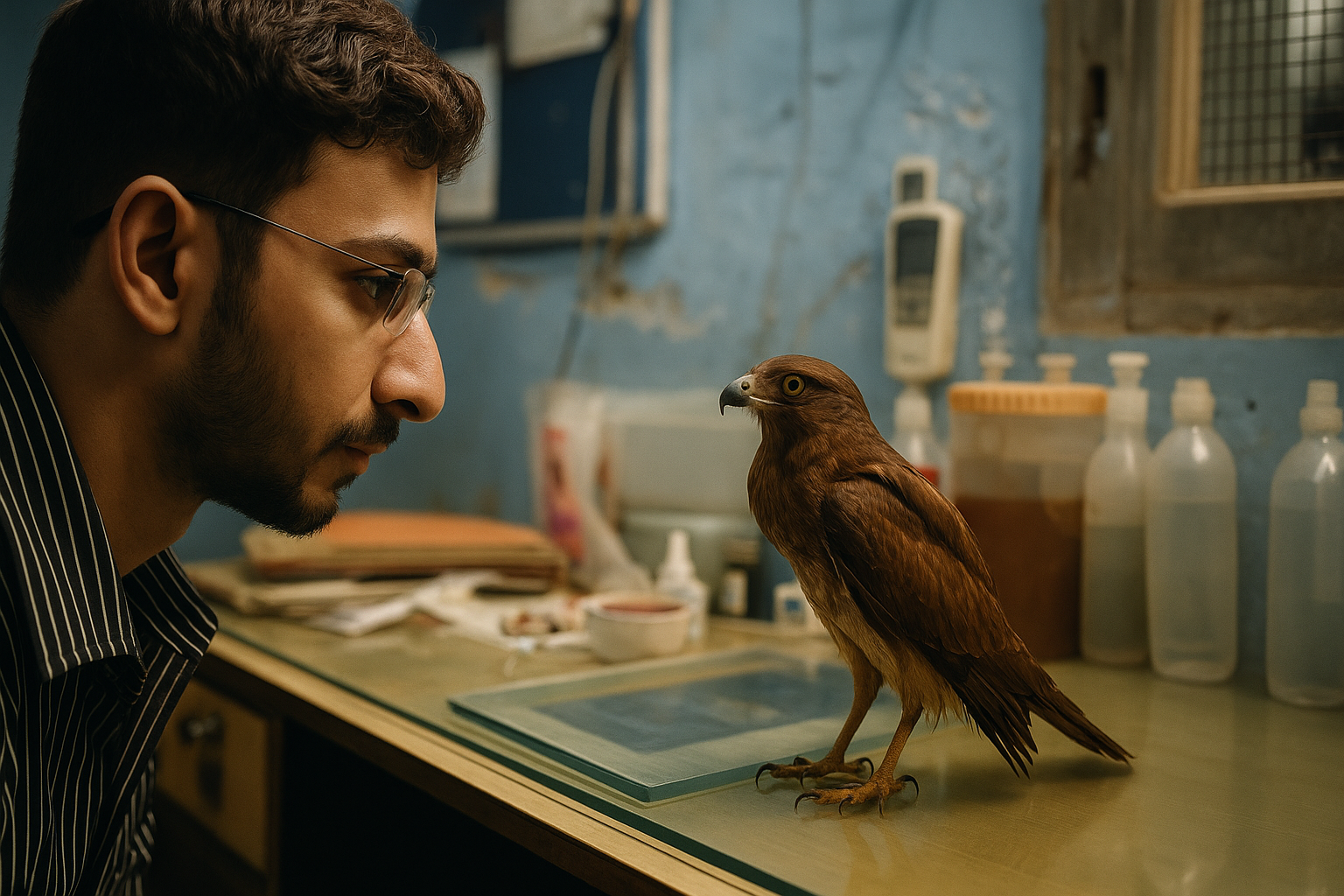
“Life, in short, is a movement of opening, not of closure. As such, it should lie at the very heart of anthropological concern.” (Ingold 2011:4) Life in anthropology is largely centred around humans, but human lives are not untouched by other living beings and vice versa. Hence, a discussion on being shall not isolate any life form. With this premise at the outset, this essay endeavours to revisit the themes and ideas that could be connected to an intertwined existence of human and non-human species. “All That Breathes” is not like a conventional wildlife or climate change documentary. There are no expert interviews or on-screen statistics to scare viewers. Instead, we learn about the struggles of carnivorous birds in Delhi through Nadeem Shehzad and Mohammad Saud, who are also dealing with their own difficulties in a region plagued by social, political, and religious issues.
Amidst the rapidly transforming urban, metropolitan life in Delhi, inflating prices of necessities and deteriorating air quality keep everyone on guard. The inability to look beyond mundane life, routine work and commuting rush in an overcrowded ‘jungle’ of mortar and cement is an everyday reality for those residing in the country’s capital. With a hundred strands of thoughts in my head, I dozed to sleep listening softly to City Life. “I can sing to the clouds, sing to the rain/ It won’t mean a thing in these packed trains……..I close my eyes to honey bees and butterflies /I wonder why they fell trees and how they aim to breathe/ While we all chase the love /We all chase the cars /We all chase the good life/ With broken hearts/ I claim to be this person, not selfish not greedy/ Well, that’s not me, it’s hard to be….”
What a person may through in an urban setup is captured melodiously in this song by Raghav Meattle. This inspired me to connect the lyrics and an entry point into All That Breathes. However, the city in which our story is based is not an ordinary one. This is Delhi, and not somewhere in the heart of the city or Lutyens Delhi, but situated on the outskirts with suburban infrastructure and horrible pollution levels. Despite the odds, the documentary showcases everyday acts of kindness, selflessness, and acknowledgement of living beings with whom we cohabit. The introductory scene in this cinematic piece for initial three to four minutes did not show bustling lanes of the city or marketplace, filthy roads full of potholes, or industrial waste discharged into supposedly ‘holy’ waters of the Yamuna forming a layer of white foam over its surface. Instead, the director chose to begin it with sounds and sight of rodents and lights from vehicles at night.
It is no coincidence that mice are feeding on a garbage dump. They are shown because they are part of the larger food chain that we would see being disrupted indirectly because of human activities. Then, in a white background, the title of the documentary unfolds, and a bird is seen floating in a grey-hued sky, with the sound of wind well captured and amalgamated into this shot. It is floating and not flying because a black kite does not flap its wings in the sky. It appears to be swimming in there.
This gives a serene and calm entry point into the otherwise moving imagery in the entire running time. The documentary engages its audience with captivating, well-shot visuals and poetic narration for one hour and thirty-two minutes. It can be watched on platforms like HBO Max, Jio Cinema and Amazon Prime Video. In total, “All That Breathes” has won 19 awards, and has 39 nominations, including an Academy Award for Best Documentary Feature. (KCRW 2023) It was also awarded World Cinema Grand Jury Prize at Sundance and Golden Eye award at Cannes. What is presented to us is a triumphant tale of two compassionate brothers who dedicate their time, energy and finances to run a small bird clinic for wounded birds (mostly prey birds) in a claustrophobic, poorly lit, unventilated basement with few resources. The documentary features many protagonists, and only mentioning the brother duo and their team would be unfair to the larger theme of life under which pretext this film was envisioned in the first place. Delhi itself is symbolically understood as a living and evolving being.
According to the narrator, their interest in lifeforms other than humans was piqued by childhood stories of djinns, spirits, trees, fungus, serpents, insects, all forms of vegetation, and other beings who, as their Ammi (translation mother) would say “jo saans lete hain” translation “all those who can breathe”. It might have inspired the makers to name this documentary, ‘All That Breathes’. Their primary understanding of muscles and injuries came from Nadeem and Saud’s teenage years when they used to be bodybuilders and fitness freaks. In those days, they came across injured birds. “This was the first time that the duo saw how birds fall prey to injuries and even death due to excessive kite flying. Manjhas, which are synthetic kite strings coated in metal or glass, can be fatal to birds flying in the sky — they can lose their wings, leaving them permanently grounded. Nadeem says that after being injured, many of these birds end up in the gutters or on the roadside, where they are run over by vehicles or bleed to death. Otherwise, the trauma of being unable to fly is soon followed by death.” (Nitnaware 2022)
Since then, there has been no turning back. To date, they have saved over twenty-three thousand birds from over a hundred species, which include owls, hawks, kites, water hens, and egrets, rescued them and gave them wings again. These are not amateur healers and are quite well-trained in bird treatment. At 13 minutes, Saud, on a very quick examination, diagnosed a nestling with MBD, which is metabolic bone disease. These instances inspire its viewers to pursue life’s mission with zeal, overcoming the odds that they come across. Saud and Nadeem had to drop out of school education due to their family’s financial condition. This also tells us that institutions of formal education can supplement our learning, but actual skills develop in the outside world. However, in the final scene, one of the brothers goes to the US for further training to become proficient at what they do.
Life forms are interconnected to each other in an ecosystem wherein an Anthropocentric approach can hinder a broader understanding of ‘Being’. Ecological Anthropology is the study of relationships between a population of humans and their biophysical environment. It investigates the contact with and the reciprocal impacts of humans upon the land, climate, plant and animal species in their vicinities through time. This discipline might help us better explore such relationships in more depth.
In my opinion, there is something addictive about life that makes all creatures endure against the harsh odds that they encounter and a zeal for fighting them away. Something that all beings share in common, a fawn in the mouth of a leopard would not easily accept its fate and succumb to death; it would resist as much as possible with all its might. So is the case with all living creatures, starting from a grasshopper who does not want to become the food for a frog, a frog for a snake, a snake for a vulture and so on. Despite this resilience, the food chain and food web continue to nourish biodiversity. What becomes unnatural is human intervention and destruction of the natural habitat of these beings. They have also learnt well to adapt themselves to human beings present around them over the dawn of the past few centuries.
The narrator observes at 39:15 that often they would find cigarette butts in a cage, only to realise later that it was used as a parasite repellent for the bird. He brings out a powerful expression then, “evolution favours experimentation”. (It is to be noted that these birds also feed on a garbage hill situated in the eastern district of Delhi, where plenty of parasites can be found). Apparently, there are no scenes where one could see a human and a bird bonding like they would if they were their pets, but at 35: 50 minutes, Salik admits that the way this bird was given a warm bath reminded him of his mother who used to bathe him as a child. In another instance, Saud’s own child is seen coughing badly due to changing air, this was meant to explain that air does not distinguish between human and non-human species and affects everyone with equal rigour. The narrator also claims at last that ‘life is also a type of kinship and that’s why we cannot abandon birds, we are all a community of the air.
In a conversation at 58 minutes, Salik and Nadeem fancy getting a Mercedes as an ambulance for their bird hospital. This shows that young professionals are not devoid of materialistic desires and a luxurious lifestyle in the city. However, the financial support they receive from FCRA funding is only sufficient for expanding and building their clinic. More support for their work might have been channelled after the success of this documentary. In retrospect, they might as well have been very rich and successful businessmen if they had not devoted their time and resources to this clinic.
This brings us to the song City Life again, where love, wealth, comfort, and fame are sought by all. But something more than these worldly pleasures becomes valuable, a different kind of satisfaction, probably unnamed throughout this narration. The missing name of this emotion could be sensed by viewers as well. At one point, a flying remark about getting sawab (religious credit) for feeding meat to kites is mentioned, who, according to the belief, seem to take away the problems of those who feed them. This can be another angle to view their intention as well as motivation to continue their work.
A dialogue on change in air and environment, which impacts all life forms alike, cannot be concluded without acknowledging the role of the atmosphere and how it affects our everyday beings. “An atmosphere is not an inert context but a force field in which people find themselves. It is not an effect of other forces but a lived affect- a capacity to affect and to be affected that pushes a present into a composition, an expressivity, the sense of potentiality and event. It is an attunement of the senses, of labors, and imaginaries to potential ways of living in or living through things.” (Stewart 2011: 452).
Stewart argues that our lives are shaped by invisible yet powerful forces, like moods, rhythms, and subtle feelings in our environment. She calls these “atmospheric attunements” and describes them as the way we instinctively connect with the world around us. These atmospheres aren’t just background noise; they actively shape how we live, think, and feel, creating new ways of being. Her work encourages paying attention to the small, often unnoticed details that define everyday life. On the front stage, we can see a bunch of dedicated men spending their energies collecting and curing wounded birds. In the background, there are situations that need their attention. They are all followers of Islam and, hence bothered by increasing hatred and angst against their community with the rise of cultural nationalism politics since regime change. Change in the air is not just felt in worsening AQI figures, but by increasing violence and crime, riots against one specific group. It has been reiterated several times in the documentary, the slogan to protect ‘samvidhan’ or the constitution. The need to do so is uncontested. (BBC 2024)
In Life and Words: Violence and Descent into the Ordinary, Veena Das presents an account of how extreme violence becomes woven into the fabric of everyday life. She examines in detail the trauma and remnants from fractured memoirs of the 1947 partition and the Anti-Sikh riots of 1984, which took place after the assassination of Indira Gandhi. She emphasises that these events are not isolated moments; instead, they “fold into” the ordinary. They infiltrate daily life, becoming part of the ongoing relationships, rituals and memories.
She argues for the inseparability of critical historical moments from everyday acts of survival, grieving and community-building. In this documentary, apart from the treatment of birds, socio-political relevance and updates on the 2020 anti-Muslim riots in northeast Delhi and the protest at Shaheen Bagh against the Citizenship Amendment Bill can be heard in the background either through dinner conversations or television news. This makes the audience wonder, under these circumstances, where a minority has fear of being deported to Bangladesh and Pakistan for not being citizens of India, these two brothers are continuing their noble task of caring and treating injured ‘cheels’. The overall commentary is on how man interacts with nature and their own social, political, and economic constructs.
Many powerful quotes highlight the severe environmental problems and the connection between different species. For example, “The kites saved me more than I saved them” shows how humans and animals depend on each other and suggests that humans aren’t always more important or on top of all species. Another quote, “Humans often forget they’re also pieces of meat,” reminds us that we share common weaknesses with other creatures. A lament where it is said “Things are getting from bad to worse here. Birds are falling from the sky,” makes us aware of the worsening environment. These messages prompt viewers to think about our shared planet and uncertain future. There were once Wright Brothers who laid foundation for humans to fly without wings and today we have this duo who are enabling avians once again to stay afloat in skies (where they belong), whose flight has been affected by human intervention into the natural world.
References
- BBC. 2024. “Citizenship Amendment Bill: India’s New ‘Anti-Muslim’ Law Explained.” BBC News, March 12.
- Das, Veena. 2007. Life and Words : Violence and the Descent into the Ordinary. Berkeley: University Of California Press.
- Ebert, Roger . 2022. “All That Breathes Movie Review (2022)
- Ghosh, Bishnupriya, and Irina Leimbacher . 2023. “All That Breathes.” DOCALOGUE. May 1.
- Ingold, Tim. 2011. Being Alive : Essays on Movement, Knowledge and Description. London ; New York: Routledge.
- KCRW. 2023. “‘All That Breathes’ Takes an ‘Unsparing Look of What Is Beautiful and Not so Beautiful.’” KCRW. February 24.
- Nandani, Neha , and Mahesh Kumar Meena. 2024. “Human and Non-Human Co-Existence in the Urban Dystopia: Review of the Documentary All That Breathes.” Environmental Communication Vol 18 (No. 7). Taylor & Francis: 1–4.
- Nitnaware, Himanshu . 2022. “From a Makeshift Clinic at Home, Siblings Rescue 23,000 Birds over 20 Years.” The Better India. March 3.
- “Raghav Meattle (Ft. Aman Shreshta, Andrea Pinto, Kirti Virmani, Naina Meattle, Nishant Nagar, Prerana Das & Raghav Meattle) – City Lights.” 2020. Genius.
- Stewart, Kathleen. 2011. “Atmospheric Attunements.” Environment and Planning D: Society and Space 29 (3): 445–53.
- Vetticad, Anna M M. 2023. “The Secrets of ‘All That Breathes.’” Himal Southasian. March 11.


Leave a Reply