
Abstract
This is a guidance article on how to get a Ph.D. admission in Banasthali University, one of the biggest and best universities for women’s education in India, located in Tonk, Rajasthan. This article is helpful for those who are searching for alternative options for the Ph.D. This article will highlight crucial points, including eligibility criteria, selection process, fellowship, research support, research environment, hostel facilities & other required points which are important to consider before taking admission.
Introduction
What started as a small initiative to educate girls has evolved into one of the prestigious universities in India. Banasthali Vidyapith was established in the year 1935 with the vision of unifying spiritual values and scientific achievements of the West and the East. This deemed-to-be university offers a wide range of academic programs extending from primary schooling to doctoral degrees. The university offers Ph.D. programs across a wide range of disciplines, including science, management, humanities, social sciences, education and technology. There is a total of 33 subjects in which the research facility is available.
It offers a Ph.D. admission process under University Grants Commission (UGC) Guidelines in both full-time and part-time modes. Though it’s a women’s university, male candidates are also eligible to take admission here in selected programs. This article provides a detailed examination of the PhD admission process at Banasthali Vidyapith. This article aims to guide aspiring candidates through every step of the admission.
Eligibility
Banasthali University follow guidelines for PhD admission outlined by the UGC. To be eligible for admission, a candidate must have completed a one-year (two-semester) master’s degree program following a four-year (eight-semester) bachelor’s degree program, or a two-year (four-semester) master’s degree program following a three-year bachelor’s degree program. Alternatively, candidates holding qualifications declared equivalent to a master’s degree by the relevant statutory regulatory authority in a related or allied field are also eligible, provided they have secured at least 55% aggregate marks or an equivalent CGPA. A relaxation of 5% is applicable for candidates belonging to SC, ST, Differently-Abled, and EWS categories.
Selection Process
In alignment with the revised Ph.D. regulations introduced by the UGC under the National Education Policy (NEP) 2020, Banasthali Vidyapith has adopted a three-category scheme for Ph.D. admissions from the academic year 2024–25 onward. Under this framework, Category 1 includes candidates eligible for Ph.D. admission with Junior Research Fellowship (JRF); Category 2 includes those eligible for admission to the Ph.D. program without JRF; and Category 3 includes candidates eligible only for admission to the Ph.D. program but not for the award of JRF
For candidates under Categories 2 and 3, the final selection will be based on a composite score, with 70% weightage given to the NET test score and 30% to the interview or viva voce performance. The NET marks for these categories will remain valid for a period of one year for Ph.D. admissions. The university conducts its own entrance test, i.e. RET– Research Entrance Test, to offer admission into the PhD. program. Qualifying RET is mandatory
RET (Research Entrance Test)
| Mode of RET | Virtual |
| Duration of RET | 120 Minutes |
| Paper Pattern (Syllabus given on website) | Total 100 MCQs -50 Questions on Research Aptitude -50 Questions on Relevant Subject |
| Marking Scheme | Each Question carries an equal mark. No negative marking. |
| Passing Criteria | 50% Marks required to qualify. (5% relaxation is given to SC/ST/Differently-abled candidates) |
Qualified students are called for an interview based on the number of Ph.D. seats available. The admission is based on a combined merit of 70% marks in the entrance test and 30% in the interview. Those who have qualified NET/JRF, SLET, GATE, GPAT or M.Phil. with 55% and candidates hailing from the Departments of Performing Arts, Visual Arts, Design or Architecture, are exempted from RET. However, exempted candidates will be required to qualify interview. After the interview, candidates who are selected for admission must visit the university in person to verify their academic documents and complete the fee submission process. In case a candidate is unable to provide a particular document at the time of verification, the university allows a grace period of 15 to 30 days to submit the missing document. This ensures flexibility while maintaining the integrity of the admission process.
Fee Structure
The Vidyapith categorises its PhD. Program into two academic groups, Group A and Group B, based on the nature of the discipline. Group A includes the disciplines that are mainly theoretical or conceptual in nature and require lower laboratory assistance, such as Humanities, Social Sciences, Fine Arts (Performing Arts, Visual Arts), Journalism & Mass Media. Group B includes the disciplines that are experimental, research-intensive and require access to laboratory and specialised equipment such as Mathematics and Computing, Physical Sciences, Automation, Life Sciences, Earth Sciences, Management, Education, Home Science, Design, Architecture & Planning, Nursing and Law. This categorisation directly affects the annual education fee.
A detailed breakdown of the entire fee structure is given in the table-
| Fee Particulars | Amount (INR) |
| Application Fee | 1,000/- |
| Admission Fee | 5,000/- With application form |
| Enrolment Fee | 10,000/- With application form |
| Educational Fee Group-A Group-B | 67,000/- Per annum 90,000/-Per annum |
| Registration Fee | 20000/- At the time of synopsis |
| Supplication Fee | 50,000/- At the time of thesis submission |
| Security Fee | 20,000/- Refundable |
| Hostel Fee | 60,000/- Per annum |
A 50% waiver on the education fee is provided for UGC JRF/SRF qualified students.
Fellowship for scholars
Non-JRF/SRF scholars are eligible for a fellowship amount of 11000/- per month, subject to daily attendance at the respective department and mandatory hostel stay.
Campus Overview
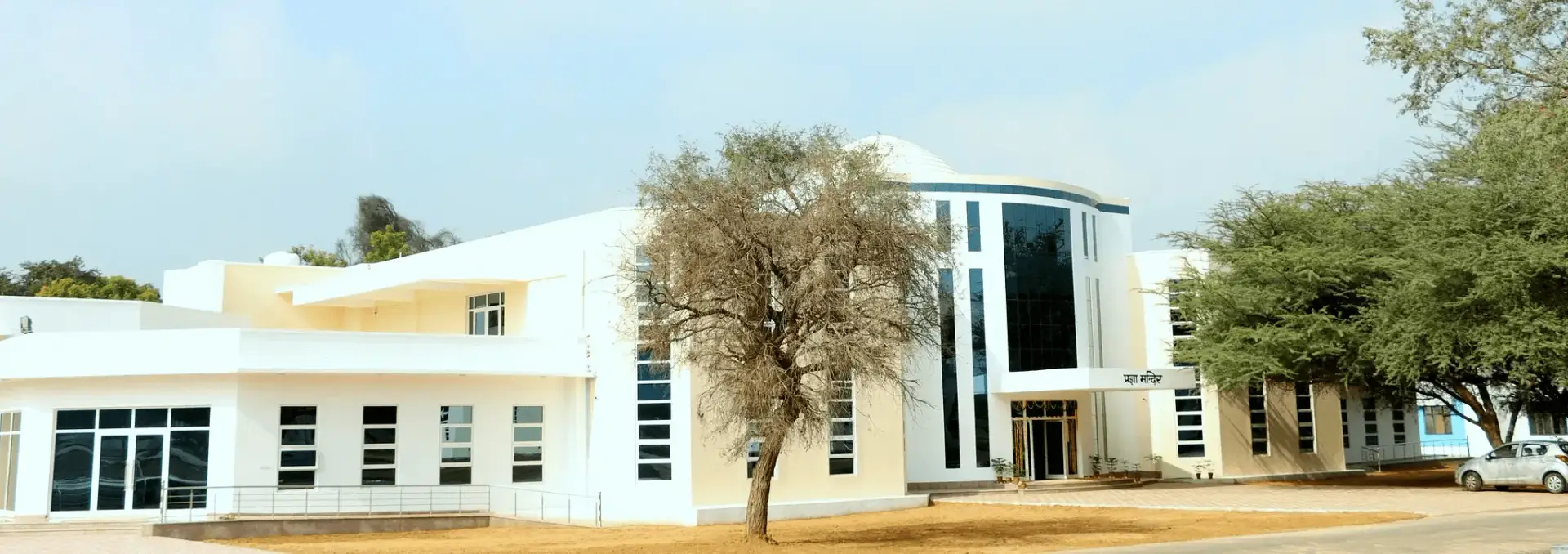
Banasthali Vidyapith has been a leading educational institution in India. It has been accredited with an A++ grade by the National Assessment and Accreditation Council (NAAC). It was also featured as second second-best private and deemed a multi-disciplinary university in the THE WEEK-HANSA Research Survey 2025, reflecting its unwavering commitment to academic excellence and strong national reputation in higher education. The university is located near Jaipur District, Rajasthan and has an area extending to 850 acres. The university campus has modern infrastructure encompassing libraries, hostels, sports, labs and more while preserving its traditional ethos.
The campus features a well-equipped central library. In addition to the central library, there are 12 department libraries as well. The library collection exceeds 5 lakh records, including books, reports, theses, manuscripts, journals, dissertations, albums, and many more. The primary objective is to develop a comprehensive repository of knowledge to cater to academic and research needs. Research labs here are fully Wi-fi enabled and remain open from 08:00 am to 08:00 pm. Research labs provide researchers with a conducive environment to work efficiently. The university has a total of 52 hostels, including two (Shanta Nikunj & Shanta Sanjavanam) dedicated exclusively to research scholars. Hostel accommodation is available only for female students. All hostel rooms are furnished well and equipped with essential amenities except Wi-Fi. Each hostel is served by a centralised mess facility. The university provides both single and shared room options to accommodate students. The campus has extensive infrastructure for sports activities. It features well-maintained outdoor fields for games such as hockey, cricket, horse-riding, volleyball, basketball, tennis, and martial arts. Adequate space for indoor sports is also available.
The Coursework
Coursework classes are held twice a week, exclusively on weekends and conducted in virtual mode for the convenience of working professionals. The duration of coursework is generally 3 months. The coursework is designed to build a strong research foundation. The coursework syllabus includes Research Publication and Ethics, Research Methodology, and IT-based Research. The syllabus is the same for all disciplines. Each subject is taught by different professors.
Strengths of the university
The Vidyapith offers Ph.D. programs in over 30 subjects, including fast-growing fields such as Artificial Intelligence, Automation, and Data Science. The university provides a safe, supportive and engaging environment for female scholars. The university provides fellowship support to scholars, which helps scholars, especially from marginalised sections. It follows the “Panchmukhi Shiksha” (Five-fold education) philosophy – encouraging researchers to develop in all areas – physical, practical, emotional, moral and intellectual. The university has built excellent research facilities to help scholars carry out innovative and meaningful research. Faculty members are approachable and supportive. Also, scholars are granted full freedom to choose research topics in alignment with their area of interest, allowing variety and flexibility in research. Research administration is responsive, and paper trails are quick here.
Weaknesses of the university
While the Vidyapith has notable progress in relation to research, it still lacks a vibrant research culture. One of the major concerns is that it lacks an interdisciplinary research approach. Although it offers a wide range of subjects, there is limited collaboration between departments. Another significant challenge is the lower publication and citation visibility in high-impact global journals, questioning the reputation of the Vidyapith. Additionally, there is limited evidence of strong research collaborations with top universities and research centres. Consequently, scholars may miss out on valuable exposure. Besides this, limited access to online resources is available for scholars. Furthermore, the faculty specialisation is also uneven across departments. Limited faculty expertise narrows the quality and scope of research. As the coursework syllabus is the same for all, it solely focuses on research basics while ignoring the specialised demands of particular academic streams.
Contact to university
Website: http://www.banasthali.org/
Mail address: researchbanasthali@banasthali.in




Leave a Reply