
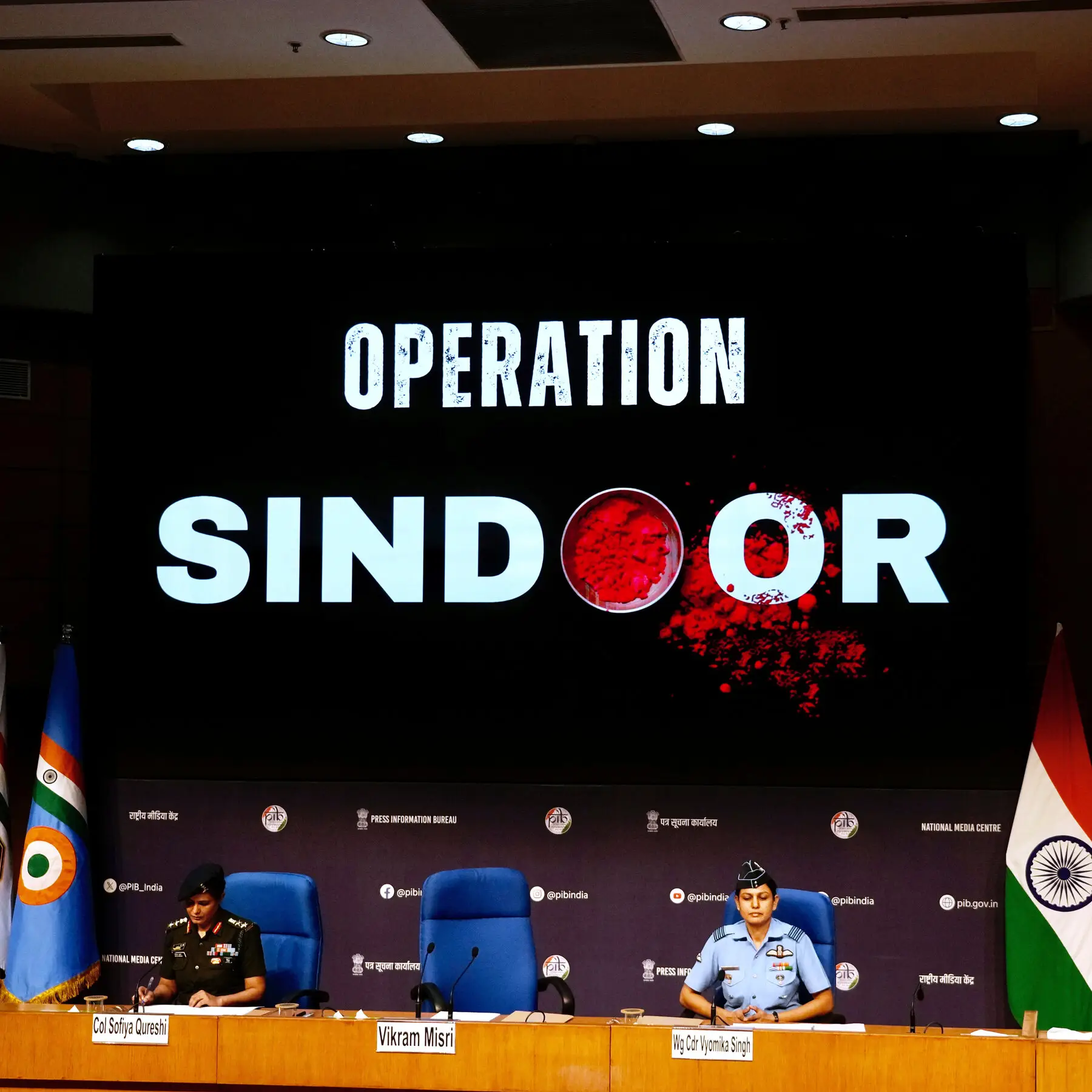
The brave retaliatory operation Sindoor was a brilliant example of the superiority of Indian military capabilities against Pakistan. Militarily, it was a significant achievement, but there was a strong, unsatisfactory, and critical response immediately after the ceasefire announcement. Why was there such a serious reaction, and how did the Indian perspective of military actions influence this response?
Modern warfare differs significantly from traditional warfare. In traditional warfare, the primary achievement was the attacking capabilities. But in modern warfare, defense represents a major achievement. Defense has become a major aspect today, especially in today’s social media era. All casualties matter greatly, making it nearly impossible for the government to hide deaths resulting from military actions. This is where defense gains even more significance. We often hear about the high casualty figures in 20th-century wars, which largely exist as mere statistics. However, even a small number of casualties today would pose a serious issue both nationally and internationally.
In Operation Sindoor, defense represents India’s most notable achievement. Pakistan has entirely failed to execute a deep-level attack on India. Apart from Jammu, Jaisalmer, and Amritsar, no other major cities have faced enemy attacks. Jammu, Jaisalmer, and Amritsar remain particularly vulnerable due to their proximity to the Line of Control and the international border. Consequently, it becomes challenging for the armed forces to prevent enemy attacks, but with the support of indigenous defense systems and Russian-made S-400s, India has effectively thwarted nearly all major enemy assaults on these border cities.
Meanwhile, Pakistan has completely faltered on the defensive front. India successfully breached Pakistan’s defense system. A country that can target its enemy’s national capital and military headquarters holds a winning position. In conventional warfare, land combat served as the main aspect of conflict, with military personnel and civilian casualties being primary targets to gain an advantage over the enemy. However, in today’s context, even a few civilian casualties can shift international opinion against you and result in severe criticism. Therefore, modern military objectives now primarily focus on the enemy’s critical military assets.
This is precisely what has happened in Operation Sindoor. According to confirmed sources from the Indian armed forces, along with images and videos, India successfully struck critical military assets in Pakistan. India attacked 11 major and strategically important air bases in Pakistan, including critical locations such as Nur Khan, Sargodha, and Skardu.
A precise military strike by Indian forces on enemy positions, breaching Pakistan’s defense systems and targeting major, strategically essential locations, puts India in a militarily advantageous position. If India was in a winning position after Operation Sindoor, why was there an unsatisfactory and critical reaction from the public immediately after the announcement of the ceasefire? To understand this, we must consider the Indian perspective on the war. What are the public’s views on military actions, and how does domestic political consumption raise expectations for such actions significantly influence the general public’s reaction?
“India’s relations with Russia and Israel, along with the aggressive military doctrines of these two nations and their influence on domestic politics, significantly shape public perception. Political rhetoric often raises public expectations to such a level that realistic strategic decisions—such as a ceasefire—may appear disappointing, even if they are militarily practical and necessary.”
Why was the unsatisfactory reaction to the ceasefire?
The unsatisfactory response to the ceasefire was due to two main reasons. The first was related to the diplomatic mishandling of the issue. The second stemmed from Indian’s perception of the war or military action.
Both Russia and Israel significantly influence the Indian mindset due to their relationship with India, particularly in terms of military support. For example, during the Israel-Gaza conflict, there was strong support from the general public in India for Israel, and, to some extent, also for Russia during the conflict with Ukraine, which has long been one of India’s largest military suppliers.
The proximity of India to both of these countries was also evident during Operation Sindoor. One of the two major weapons used by India against Pakistan were drones and a defense system. The drones were supplied by Israel, while the S-400 defense system was a Russian weapon.
Both countries, Russia and Israel, are currently at war with their neighbors, and both countries also follow a very offensive military strategy. Russia is fighting against Ukraine, and Israel is against Gaza. By following an offensive strategy, Russia has taken a substantial part of Ukrainian territory during this ongoing conflict. On the other hand, Israel has destroyed and devastated Gaza in its retaliatory actions against Hamas’s terrorism.
Both Russia and Israel are frequently used for domestic consumption by politicians, particularly by BJP politicians, to demonstrate their commitment to national security and leverage nationalism, and it has shaped Indian perception of the war or military action.
By this notion of the war, we have seen many demands, such as the takeover of POK, Balochistan, and the division of Pakistan into different sovereign states. It is also true that India is committed to reclaiming POK and supporting Balochistan in its liberation movement, but every military action and war has its objectives.
The operation Sindoor was not intended to secure a long-term commitment from India. Instead, it was a retaliatory military action against terrorist activities by Pakistan in the Indian state of Jammu and Kashmir. The Indian Government and armed forces have clearly stated that, after the operation Sindoor, the main objective was to target terrorist camps and training facilities without harming military assets or civilians in Pakistan with precision strikes.
Given the objectives of Operation Sindoor, it was a highly successful military action in its initial phase. However, heavily influenced by the concept of Israeli and Russian military actions, the Indian public desired results that exceeded the operation’s objectives.
In the second part of the operations, Sindoor, many Indians felt their expectations would be met when news began to arrive about striking Pakistan’s important and strategic air bases. However, unexpectedly, when reports of the ceasefire surfaced, a strong and unsatisfactory reaction was observed from the general public because the ceasefire confirmed the unfulfilling of the public’s expectations.
President Donald Trump’s announcement of the ceasefire heightens this dissatisfaction. It came as a complete shock to India. However, as time goes on, things are becoming clearer, and we are witnessing a positive response from the public.
In summary, when discussing the objectives of Operation Sindoor, it is clear that it was a highly successful military operation that exceeded its goals and sent a strong message to Pakistan and its military regarding terrorism. However, the public had greater expectations following the offensive military strategy. A ceasefire was viewed as a barrier to these expectations, and the sudden announcement of a ceasefire generated significant dissatisfaction and a critical response from the public.


Leave a Reply