
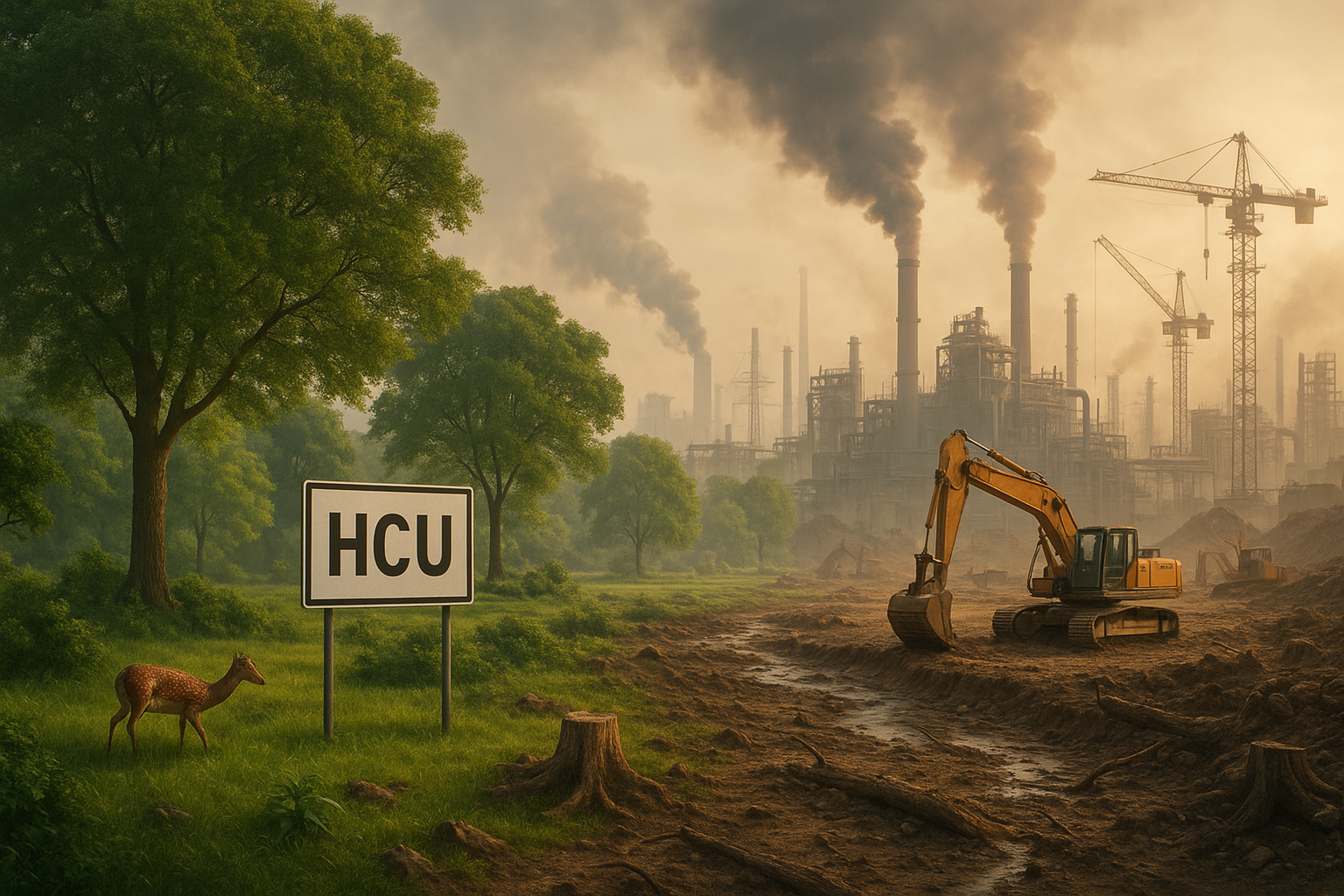
The recent controversy over 400 acres of land in Kancha Gachibowli near Hyderabad Central University (HCU) in Telangana has brought again to the fore the question of environmental degradation and the developmental model which is being followed in India. The move by the congress led government in Telangana has been met with stiff opposition from the Bhartiya Janata Party (BJP), which is trying to position itself as a defender of environmental rights. However, the BJP’s opposition in Telangana is in stark contrast to its active role in dispossession of land in similar cases elsewhere.
This contrast underscores a broader reality: when it comes to question of environment, development and land dispossession, political parties across the ideological spectrum from the right to left, share a common ground in favouring industrial expansion over ecological sustainability and people’s rights. Although there is an ideological difference among them, all major parties in India have facilitated land acquisition for industrialization at the cost of environment.
While each party engages in ‘selective outrage’ depending on its position in opposition or government, no party has challenged the structural violence which is inherent in the developmental paradigm of India. Political actors in India use environmental concerns to serve their electoral interests.
The idea of development
We generally understand the idea of ‘development’ in an often neutral and progressive sense, but it is highly ideological (Saxena, 2010). The idea of ‘development’ which we know today was politically constructed, particularly after the speech of President Truman in 1949, which divided the world into “developed” and “underdeveloped” nations (Esteva, 2019). This division of the world justified interventions by industrialised nations into the Global South, promoting economic models rooted in capital accumulation and industrial expansion.
As was in the case of India after the adoption of liberalisation, privatisation, and globalisation (LPG) policies in the early 1990s, by which India had to swallow the poison pill of Neo-liberalism (Harvey, 2007), this led to acceleration of the process of opening vast tracts of forests and mineral-rich regions to private capital. This transition marked a significant shift from state-controlled to corporate-driven development, where local communities were displaced with minimal safeguards.
The way land acquisition policies operate in India (Land acquisition act, 2013), there is a prioritisation of neo-liberal model of development over ecological balance, thus reducing indigenous communities and marginalised groups to mere roadblocks in the way of industrial expansion.
Selective outrage of the parties
The BJP’s opposition to the Telangana government’s land acquisition efforts reveals its selective outrage to environmental and land rights issues. While it supports the cause of students and activists in Hyderabad, the party has actively enabled land dispossession elsewhere. Most prominent and recent example is that of the Hasdeo Arand forest in Chhattisgarh. It is one of India’s largest contiguous forest tracts that has been set aside for extensive coal extraction, and despite widespread protests and environmental concerns, the government has permitted corporate entities to acquire land for mining purposes (Congress is also complicit in this).
The tribal community has been protesting against the coal mining projects to protect the ecologically sensitive region Similar to this, the BJP has also been instrumental in promoting industrial projects in Jharkhand at the expense of tribal land rights.
In 2016, the BJP government led by Raghubar Das attempted to amend the Chotanagpur Tenancy Act and the Santhal Pargana Tenancy Act, which prohibited the transfer of Adivasi lands to non-Adivasis, to allow corporate groups to access tribal land. Massive protests erupted against the proposed amendments culminating into the Pathalgadi movement, and the government was forced to abandon its plans due to strong opposition.
These instances highlight the opportunistic nature of political parties. When in power, they actively promote dispossession under the pretence of economic development. Left is no different. The Singur and Nandigram incidents in West Bengal are among the most notorious examples of land dispossession during the Communist Party of India (Marxist)-led government in Bengal. Government sought to acquire land for the Tata Nano car project in Singur and a chemical hub in Nandigram.
Although the CPI(M) government has historically supported land reforms, it used violent means to suppress protests, thus resulting in deaths and widespread human rights violations, including rapes. The CPI(M) administration in West Bengal was overthrown because of the pushback against these measures, proving that left-wing parties adopt the same industrialization centric policies when they are in power.
What needs to be done?
Despite the devastating environmental and social effects of land dispossession, mainstream political discourse in India rarely prioritises ecological sustainability. Mining and industrial projects cause deforestation and biodiversity loss, water sources are polluted, agriculture and drinking water supplies are affected, and the destruction of forests increases climate vulnerability.
Tribals and marginalized groups lose their traditional livelihoods, cutting them off from their means of production. What can be done? The Chipko movement of the 1970’s showed how grassroots movements can challenge exploitative development models, and how in Odisha, there was a successful resistance against Vedanta Resources’ mining plans. These examples demonstrate that an alternative, people-centric approach to development is not only possible but necessary.
What needs to be done is we need to move away from top-down to inclusive decision-making processes. What this ongoing 400-acre land controversy in Hyderabad reveals is that political parties from a wide range of ideological spectrums are on the same side when it comes to the industrialisation and they have at different times enabled environmental destruction in the name of the neo-liberal development.
This ‘selective outrage’ is a tool of electoral opportunism where the real stakeholders, the people, and the environment, pay the ultimate price. This also lets us question the rhetoric of the state, that development is for the people. But we need to ask the question, who are these People here?
References:
- Esteva, G. (2019). Development. In Wolfgang S. (Ed.), The Development Dictionary: A Guide to Knowledge as Power (3rd ed., pp. 8-35). Bloomsbury Academic.
- Harvey, D. (2007). A Brief History of Neoliberalism. United Kingdom: Oxford University Press.
- Saxena K.B. (2010). Development is war; Underdevelopment is benign: Political economy of Tribal Displacement in India. In A. K. Ghosh & R. D Munda (Eds.), The other side of development: The tribal story (1st ed., pp. 26-81). Konark Publishers Pvt Ltd.

Leave a Reply