
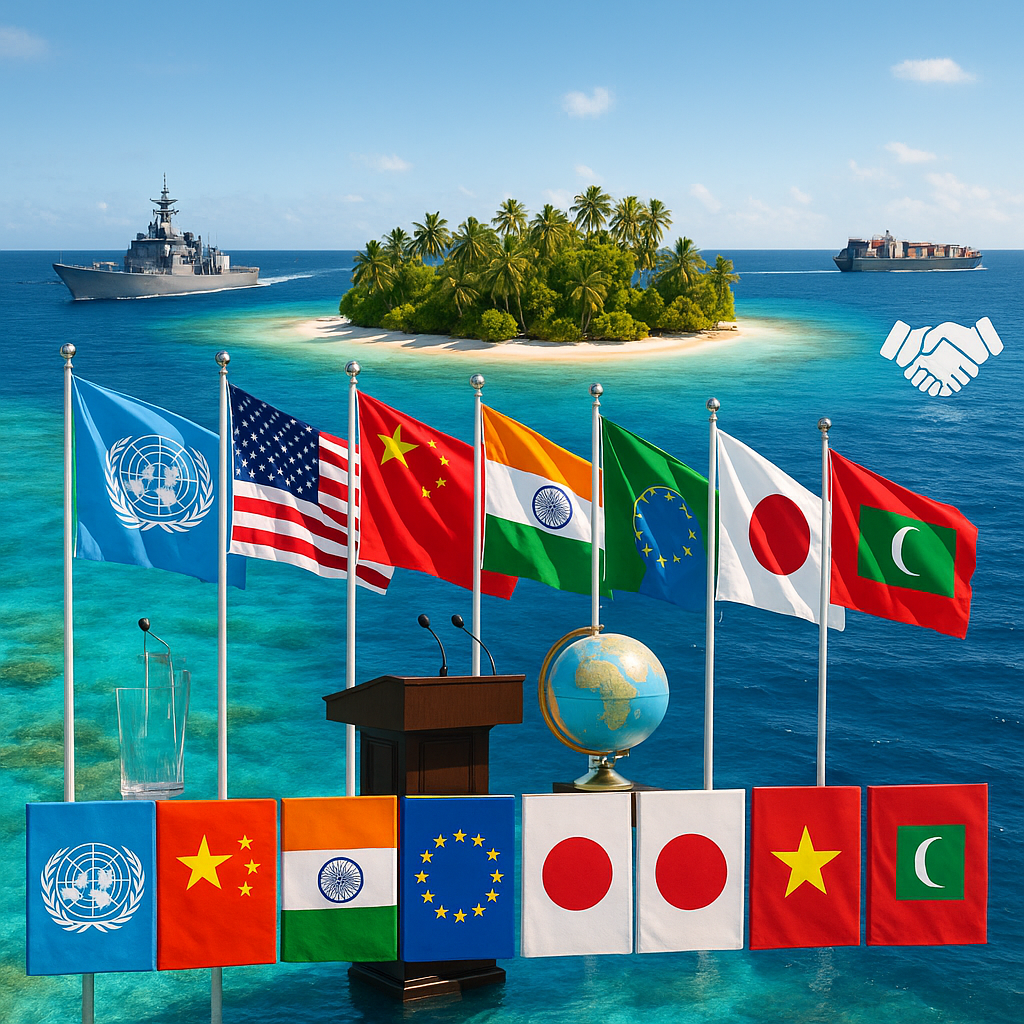
When we think of global power, our minds go straight to the heavyweights the United States, China, Russia, or the European Union. These are the players that dominate headlines, shape trade deals, and dictate the pace of global diplomacy. But far from the grand conference halls of Washington, Beijing, or Brussels, a quieter and equally fascinating kind of diplomacy is unfolding. It shows that even the smallest nations, with populations smaller than a Delhi suburb, can shift the direction of international politics.
Island nations such as the Maldives, Seychelles, and the Pacific Island states are redefining what it means to be powerful in the 21st century. They don’t rely on vast armies or trillion-dollar economies. Instead, they use geography, climate vulnerability, and nimble diplomacy as tools of influence. In a world torn between superpower rivalries and planetary crises, these small states have learned to make their size an advantage, not a limitation.
Geography as a Trump card
The Maldives, a chain of coral atolls scattered across the Indian Ocean, sits right along some of the busiest shipping lanes in the world. This location makes it indispensable to any country seeking influence in the region. For India, the Maldives is a maritime neighbour critical to its security and regional influence. For China, it is an attractive partner in the Belt and Road Initiative, offering a potential foothold in a strategically sensitive part of the world.
This tug-of-war for Malé’s friendship is more than symbolic. Whoever has influence in the Maldives gains more than just a diplomatically they gain access to maritime routes, naval cooperation, and political leverage in the wider Indo-Pacific.
Seychelles plays a similar game with equal skill. Perched near the African coast and overseeing key Indian Ocean trade routes, it has become a valuable partner for both India and Western navies. Maritime surveillance agreements, port access deals, and joint patrols are all part of the bargaining chips it uses to secure development aid, infrastructure funding, and security guarantees.
In both cases, geography functions like currency. A well-placed harbour, an exclusive economic zone, or a deep-water port can sometimes be more valuable than an arsenal of fighter jets.
Turning Climate Crisis into Diplomatic Capital
If geography is their first advantage, climate change is their second though it comes at a high cost. For nations like Tuvalu, Kiribati, and the Marshall Islands, rising sea levels are not just a future concern; they are a present-day emergency. Some may lose significant portions of their territory within the next few decades.
Yet, these vulnerabilities have become a powerful source of moral authority. At climate summits, leaders from small island states don’t speak in terms of percentages and abstract targets. They speak of survival homes disappearing under the waves, livelihoods washed away, cultures on the brink of extinction. This moral weight often forces the bigger emitters, from the United States to Australia to China, to take their demands seriously.
The Pacific Islands Forum has increasingly become a stage where climate diplomacy intersects with great-power politics. Both Washington and Beijing compete to win over these nations, offering climate aid, infrastructure support, and diplomatic partnerships. Their votes in multilateral forums carry weight, and their voices have the ability to shape the global climate agenda.
The Art of Strategic Hedging
Perhaps the most striking skill these nations have mastered is the art of balancing competing powers without becoming anyone’s pawn. The Maldives is a prime example. One administration leans towards India, inviting military cooperation and infrastructure support. The next tilts towards China, welcoming Belt and Road investments. Each shift draws fresh offers from both sides, ensuring the Maldives continues to benefit regardless of who holds power in Malé.
Fiji offers another illustration. Though far from major conflict zones, it has earned an outsized reputation at the United Nations through its contributions to peacekeeping missions. This has given it a diplomatic profile far greater than its size or economy would suggest.
This balancing act, often called “strategic hedging,” allows small states to play bigger powers against each other while safeguarding their autonomy. In a multipolar world, committing too deeply to one side can be risky. Keeping multiple channels open provides insurance against shifting alliances and changing political winds.
Rethinking Power in the 21st Century
For much of the 20th century, International Relations theory — especially realism — defined power in terms of military strength, population size, and economic output. In this view, small states were at best marginal players, their fate determined by the decisions of great powers.
But the rise of small-state influence in recent decades challenges this narrative. Soft power, moral legitimacy, and strategic geography are proving to be potent forms of influence. The concept of “complex interdependence,” developed by scholars Robert Keohane and Joseph Nye, captures this shift well the idea that power flows not just from force but from networks, norms, and mutual dependence.
Island nations are not simply surviving in this environment; they are shaping it. By focusing on niche areas where they hold an advantage whether that’s maritime security, climate advocacy, or peacekeeping they can set agendas, build coalitions, and secure tangible benefits from much larger states.
Why We Should Pay Attention
For India, the rise of small-state agency is not an abstract academic point it is a strategic reality. The Indian Ocean is no longer just a “backyard”; it is a contested arena where China, the United States, and other actors are expanding their footprints. India’s relationships with the Maldives, Seychelles, Mauritius, and other island states are not just about goodwill; they are about maintaining a secure and favourable strategic environment.
Ignoring the agency of these smaller neighbour’s risks leaving the field open for others who see and understand their value. And while India has traditionally enjoyed strong cultural and historical ties in the region, those bonds are not immune to erosion if economic or security promises fail to match the competition.
More broadly, the growing influence of small states is a reminder that the global order is not shaped only by the loudest voices. Sometimes, it is the quieter players those who know when to push, when to hold back, and when to make their move who end up shifting the game in unexpected ways.
Conclusion
In the grand theatre of international politics, small island nations may not dominate the stage, but they have mastered the art of stealing key scenes. Through strategic use of geography, the moral force of climate diplomacy, and the careful balancing of relationships, they have turned their vulnerabilities into sources of power.
As climate crises deepen and geopolitical rivalries sharpen, these nations will only grow more relevant. Their moves may be subtle, but the ripples they create can travel far from the harbours of Malé to the halls of the United Nations.
In a century where both power and vulnerability are being redefined, the story of small states is more than a diplomatic curiosity. It is a lesson in agility, resilience, and the evolving nature of influence itself.


Leave a Reply