
Abstract
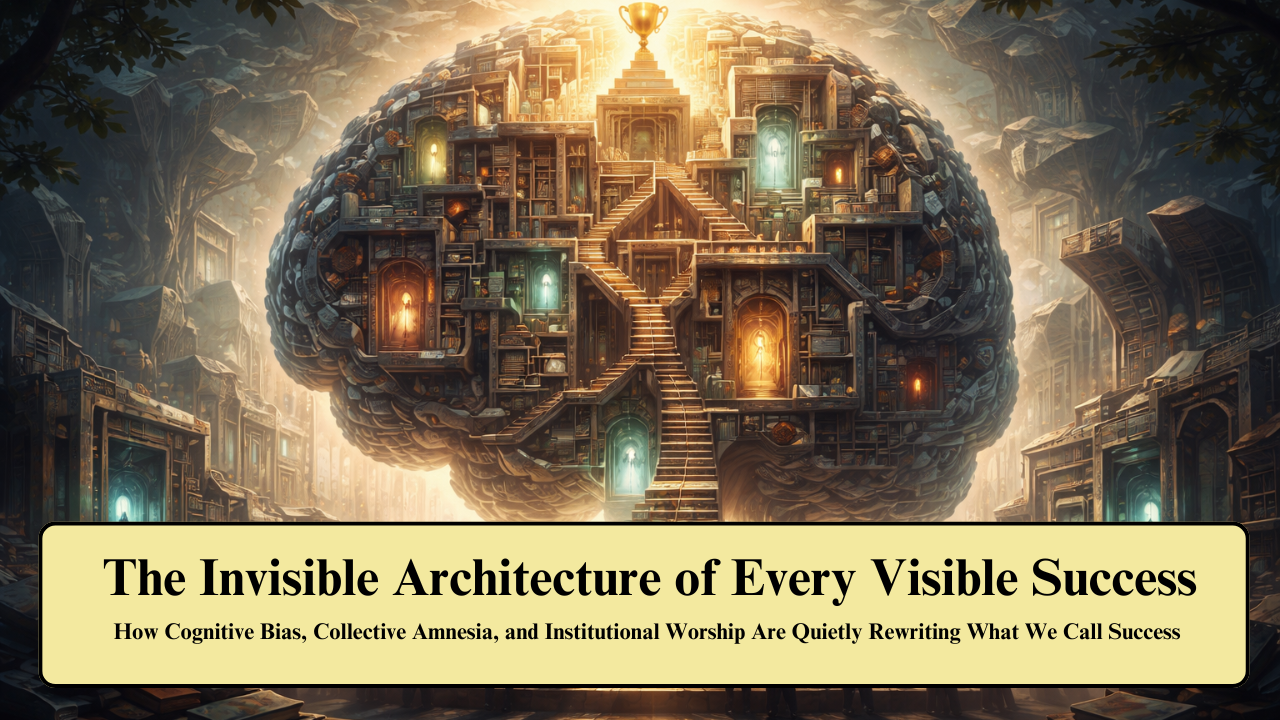
This article interrogates the deeply embedded human tendency to identify, venerate, and ultimately reduce success to a single ‘supreme’ individual. In sports arenas, academic institutions, corporate hierarchies, and the cultural imaginaries we inherit. Drawing on cognitive neuroscience, social psychology, and systems theory, it argues that this reductive instinct is not an innocent shortcut but a culturally conditioned bias that silently reshapes self-worth, career trajectories, migration decisions, and our capacity for empathy. It proposes a framework of structural thinking and expanded epistemological humility as correctives to this narrow0 and profoundly costly way of seeing.
The Hero Factory: A Very Human Problem
In 2002, Daniel Kahneman and Amos Tversky’s decades of work on cognitive heuristics crystallized into a Nobelist insight: the human mind does not reason from first principles: – Its shortcuts. It simplifies. It narrates (Kahneman, 2011). And one of its most seductive narratives, cross-cultural, cross-historical, almost axiomatic, is the story of the singular hero.
We seem constitutionally incapable of watching a cricket match and crediting the collective. We watch Virat Kohli anchor a chase under pressure, and the cultural apparatus immediately begins its rituals: the slow-motion replay, the reverential commentary, the trending hashtag. The 10 other players who set the platform, rotated strike, and held their nerve under identical pressure, they dissolve into the backdrop.
This is not merely a media failure. It is a failure of cognitive architecture.
No man is an island, entire of itself; every man is a piece of the continent. 2014 John Donne (1624). We have known this for four centuries. We just keep forgetting it.
Psychologist Philip Zimbardo famously argued that we systematically over-attribute outcomes to individual disposition while ignoring situational and systemic factors, what social psychology calls the Fundamental Attribution Error (Ross, 1977). Applied to excellence, this error becomes a cultural institution. It does not merely distort perception; it actively manufactures scarcity in domains of human worth.
The Neuroscience of Worship: Why Our Brains Go Simp Mode
Let’s be real with ourselves. When Rohit Sharma hits a six or Khan Sir drops a viral explainer, something lights up inside us, and it is not purely aesthetic appreciation. It is neurochemical.
Functional neuroimaging studies show that observing a high-status individual succeed activates the ventral tegmental area and nucleus accumbens, the dopaminergic reward circuit that also fires during food, sex, and cocaine (Moll et al., 2006). Hero worship is, at the neurological level, an addiction. We don’t just admire winners. We get high off them.
Simultaneously, the default mode network, responsible for self-referential thought, is deeply activated when we consume narratives, particularly those with a central protagonist (Mar et al., 2006). Cinematic storytelling does not merely entertain; it structurally trains the brain to search for a singular focal point of meaning in every domain of experience. This is why, after a lifetime of movies, textbooks, and LinkedIn success stories, our default cognitive mode is to scan any system, a startup, a department, a cricket team, and ask: “But who is the real hero here?”
The brain prefers a clean story over a complicated truth. The hero format is the brain’s aesthetic preference, not reality’s structure.
Howard Gardner’s theory of multiple intelligences (1983), now thoroughly supported by neurological evidence, demonstrates that human capability is distributed across at least eight distinct domains: linguistic, logical-mathematical, spatial, bodily-kinesthetics, musical, interpersonal, intrapersonal, and naturalistic. Yet, in Indian academic culture particularly, we have historically collapsed this eight-dimensional space into a single axis: entrance examination performance.
This is not intellectual seriousness. It is cognitive laziness dressed in competitive clothing.
The Institute-fication of Human Worth
Let’s engage with something uncomfortable. The Indian Institutes of Technology represent genuine excellence, technically rigorous, intellectually demanding, globally respected. Many students from IIT, NIT and IIPS graduates have made contributions to science, policy, and entrepreneurship that deserve unstinting admiration.
But something has gone sideways in the cultural metabolism of this excellence.
In a 2019 study published in Higher Education, researchers found that elite institutional branding in India creates what they termed a “credential halo effect”, a phenomenon where the institutional label overrides actual competence assessment in hiring, social prestige, and even matrimonial consideration (Trivedi & Dhawan, 2019). The institution does not merely certify competence; it replaces it as the unit of measurement.
The downstream consequences are not trivial. We have constructed a social architecture in which a rank determines not just your college but your social legibility. Students who display extraordinary aptitude in fine arts, social entrepreneurship, vernacular literature, or craft-based knowledge systems are quietly told, often without anyone saying it aloud, that their intelligence is decorative, not real.
Mihaly Csikszentmihalyi, whose seminal work on creativity and flow draws from decades of studying eminent individuals, found that the most genuinely productive human beings rarely emerged from the straightest, most legible career paths (Csikszentmihalyi, 1996). They emerged from the permission to pursue deep, idiosyncratic engagement. A system that channels all cognitive energy toward one competitive funnel is, quite literally, destroying the conditions under which its most creative citizens could flourish.
We are not producing the sharpest minds. We are producing the most efficiently optimized test-takers, which is a very different thing.
The Migration Paradox: When Social signalling Becomes a One-Way Ticket
India loses roughly 20,000 high-net-worth individuals annually to emigration, many of them highly educated professionals, a figure that places it among the top three nations globally for wealthy outmigration (Henley & Partners, 2023). The discourse around brain drain tends to frame this as purely economic: better salaries, better infrastructure, better research funding. This framing is not wrong, but it is incomplete.
There is a subtler, more psychologically complex force at work: the desire for external validation in a society that has trained its most educated citizens to define worth through external hierarchies.
In a society where IIT is the ceiling of domestic success, many graduates find that ceiling arrives too quickly. The question is not just “where will I earn more?” but “where will I be recognized as sufficient?” Sociologist Arlie Hochschild’s concept of “status shields”, institutional affiliations and social positions that protect against delegitimization, maps well onto this dynamic (Hochschild, 1983) For many educated Indians, moving abroad is not just about a better salary. It is about finally feeling like enough. The foreign degree, the Bay Area job title, the NHS badge – these are not just career moves. They are answers to a question that Indian society never stops asking: have you made it yet?
This is the insidious logic of the hero-factory culture: it does not just make people feel inadequate. It makes them feel inadequate in ways that only geographically distant validation can resolve.
The tragedy is not migration itself; human mobility is structurally legitimate and often genuinely enriching. The tragedy is migration motivated not by curiosity or opportunity, but by the psychological exhaustion of living in a culture that measures you constantly against its own extremely narrow template of supremacy.
The Invisible Architecture: What We Keep Not Seeing
Return to sports for a moment, because it remains one of the cleanest mirrors of collective psychology we have.
In a 2014 study analyzing 10 years of IPL cricket data, researchers from the Indian Statistical Institute found that team performance metrics explained match outcomes significantly better than individual player ratings, yet media coverage and fan discourse remained overwhelmingly player-centric (Mukerjee & Rao, 2014). The gap between what drives results and what captures attention is not accidental. It is structural.
The same structural invisibility shapes knowledge economies. Consider: behind every IIPS or IITs professor whose breakthrough paper earns institutional glory is a network of research associates, lab technicians, administrative staff, departmental librarians, and junior researchers whose invisible labor constitutes the actual substrate of discovery. Scientific citation practices are changing, the CREDIT taxonomy now formally acknowledges conceptualization, methodology, investigation, and data curation as distinct epistemic contributions (Brand et al., 2015). But in the cultural imagination, the Principal Investigator remains the hero.
The Dunning-Kruger literature suggests something further: those who are most confident in their singular competence tend to be least aware of the collective architecture supporting it (Kruger & Dunning, 1999). The perceived individual genius is often, empirically, the person least capable of perceiving their own systemic embeddedness.
Every visible peak is the tip of an invisible iceberg. The iceberg does not reduce the peak, it produces it.
The Anger Mechanism: Why Challenging the Hero Feels Like Violence
Here is something most of us have experienced but few examine rigorously: the visceral fury that erupts when someone challenges our chosen hero. A critique of Dhoni’s captaincy decisions, a question about Elon Musk’s management style, a measured skepticism toward an IIPS or IITs alumnus’s research victory, these provoke reactions far exceeding what intellectual disagreement warrants.
The neuroscience here is clear and slightly humbling. Matthew Lieberman’s work at UCLA established that social pain, including perceived threats to one’s social identity and group affiliations, activates the same neural circuits as physical pain: the dorsal anterior cingulate cortex and anterior insula (Lieberman & Eisenberger, 2009). When we have emotionally fused our identity with a hero, criticism of that hero is not an intellectual event. It is, to the limbic system, an assault.
The prefrontal cortex, the seat of rational deliberation, perspective-taking, and emotional regulation, gets functionally suppressed during acute amygdala activation. This is why debates about cricket captains, startup founders, or academic institutions so reliably generate more heat than light: the participants are not, in any meaningful neurological sense, thinking. They are defending.
Jonathan Haidt’s social intuitionist model of moral reasoning is apposite here (Haidt, 2001). We rarely reason our way to conclusions about who deserves admiration. We intuit first, then construct post-hoc rationalizations. The hero is loved before the evidence is assembled. The evidence is then selectively curated to fit the pre-existing love.
This is not a character flaw. It is a feature of evolved social cognition. But like many evolved features, it was designed for a social environment, small-group, immediate, kinship-dense, that no longer exists. In a mediated world of parasocial celebrity, it becomes a liability.
Toward a Systems Epistemology: What It Actually Takes to See Clearly
The antidote to hero-factory thinking is not the wholesale deflation of individual achievement. That would be its own form of distortion. The antidote is depth of perception, the trained ability to see outcomes as products of systems rather than singular agents.
Donella Meadows, in her foundational text on systems thinking, described the most common cognitive failure among intelligent people not as stupidity but as “event-level thinking”, interpreting outcomes by their surface agents rather than their underlying structural dynamics (Meadows, 2008). Event-level thinking says: “Narayana Murthy built Infosys.” Systems thinking says: “Narayana Murthy emerged from and helped constitute a specific institutional, regulatory, educational, and cultural ecology without which Infosys could not have been imagined, let alone built.”
Both statements are true. Only one is complete.
Christopher Peterson and Martin Seligman’s character strengths framework offers a practical taxonomy for expanding what we count as excellence: creativity, curiosity, judgment, love of learning, perspective, bravery, perseverance, honesty, zest, love, kindness, social intelligence, teamwork, fairness, leadership, forgiveness, humility, prudence, self-regulation, appreciation of beauty, gratitude, hope, humor, and spirituality (Peterson & Seligman, 2004). Twenty-four domains of human excellence. We systematically reward perhaps four of them in our most prestigious institutional pathways.
Lev Vygotsky’s zone of proximal development theory, foundational to developmental psychology, established decades ago that individual cognitive achievement is never, strictly speaking, individual, it is always constituted by social interaction, relational scaffolding, and cultural tool use (Vygotsky, 1978). The individual learner does not rise from within themselves. They are raised by a field. To recognize this is not to diminish the individual. It is to see them accurately.
Practical Recalibrations for the Educated Mind
1 Expand Your Attribution Vocabulary
When you observe success, resist the compression. Before identifying “the” cause, map the contributing causes, logistical, relational, historical, structural. This is not false modesty about achievement. It is honest accounting.
2 Practice the “Second Hero” Inventory
Behind every person you admire, deliberately identify three to five individuals or structures without whom that admiration would not be warranted. This is not a gratitude exercise. It is a perceptual workout.
3 Interrogate Your Anger
The next time a critique of someone you admire makes you defensive, treat that defensiveness as data. Ask: have I fused my identity with this person’s reputation? If so, what does that fusion protect, and what does it cost?
4 Diversify Your Criteria of Respect
If you find that the overwhelming majority of people you deeply admire share the same institutional pedigree, professional domain, or measurable success metric, your respect calibration has a distribution problem. Not a moral problem, a perceptual one.
5 Create Space for the Prefrontal Cortex
The ancient wisdom traditions and modern cognitive behavioural research converge on the same practical insight: between stimulus and response, a pause is possible. Viktor Frankl called it the last of human freedoms. Behavioral economists call it “System 2” activation. Whatever you call it, it is the difference between reacting from your amygdala and reasoning from your frontal lobes.
6 Redefine What Deserves to Go Viral
The attention economy will not fix itself. But educated individuals with social capital can, collectively, shift what circulates. The teammate who held the partnership together deserves a thread. The junior researcher whose methodology enabled the paper deserves a citation. The support staff whose invisible competence sustains visible performance deserves acknowledgment. Not as charity. As accuracy.
Conclusion: No Genius Is an Island
The central argument of this piece is not anti-excellence. Excellence is real. Individual achievement is real. The capacity of certain human beings to operate at the outer edges of cognitive, physical, or creative performance is one of the genuinely astonishing features of our species.
The argument is anti-reductionism, specifically, the reductionism that mistakes visibility for causality, that confuses the face of a system for its engine, and that then organizes entire cultural and educational architectures around producing more of those visible faces while systematically under-investing in the structural conditions that make those faces possible.
We have built institutions, competitive entrance examinations, corporate ranking systems, international prestige hierarchies, that operationalize a philosophy of radical individual supremacy. And we have paid a price for it in suppressed diversity, exported talent, fragile self-worth, and a growing inability to see or reward the complex, distributed labor that actually makes civilization work.
The most important shift a highly educated mind can make is from asking ‘who is the best?’ to asking ‘what conditions produce flourishing?’, because those questions have very different answers, and only the second one is actionable.
The neuroscience tells us we are wired toward the hero story. The social psychology tells us that wiring is amplified by competitive institutions and media structures. The systems theory tells us that acting on that wiring produces consistently incomplete and distorted models of how outcomes actually happen.
What the research converges on, what every field from developmental psychology to organizational behavior to network science corroborates, is that human excellence is irreducibly collective. Not in a vague, inspirational sense. In a rigorously causal one.
So perhaps the most intellectually honest thing we can do, the most PhD-worthy thing, if we want to use institutional legitimacy as our metric for a moment, is to sit with complexity. To resist the seduction of the simple story. To see what is actually there.
Not one hero. A network. Not one best. A distributed field of contributions. Not a ranking. A recognition.
And perhaps, finally, to understand that a society which learns to see this way will not produce fewer extraordinary individuals, it will produce more of them, because it will have built the conditions in which ordinary people are no longer penalized for being extraordinary in the wrong direction.
References
- Brand, A., Allen, L., Altman, M., Hlava, M., & Scott, J. (2015). Beyond authorship: Attribution, contribution, collaboration, and credit. Learned Publishing, 28(2), 151–155.
- Csikszentmihalyi, M. (1996). Creativity: Flow and the psychology of discovery and invention. HarperCollins.
- Donne, J. (1624). Devotions upon emergent occasions. Meditation XVII.
- Gardner, H. (1983). Frames of mind: The theory of multiple intelligences. Basic Books.
- Haidt, J. (2001). The emotional dog and its rational tail: A social intuitionist approach to moral judgment. Psychological Review, 108(4), 814–834.
- Henley & Partners. (2023). Henley Private Wealth Migration Report 2023. Henley & Partners.
- Hochschild, A. R. (1983). The managed heart: Commercialization of human feeling. University of California Press.
- Kahneman, D. (2011). Thinking, fast and slow. Farrar, Straus and Giroux.
- Kruger, J., & Dunning, D. (1999). Unskilled and unaware of it: How difficulties in recognizing one’s own incompetence lead to inflated self-assessments. Journal of Personality and Social Psychology, 77(6), 1121–1134.
- Lieberman, M. D., & Eisenberger, N. I. (2009). Pains and pleasures of social life. Science, 323(5916), 890–891.
- Mar, R. A., Oatley, K., Hirsh, J., de la Paz, J., & Peterson, J. B. (2006). Bookworms versus nerds: Exposure to fiction versus non-fiction, divergent associations with social ability, and the simulation of fictional social worlds. Journal of Research in Personality, 40(5), 694–712.
- Meadows, D. H. (2008). Thinking in systems: A primer. Chelsea Green Publishing.
- Moll, J., Zahn, R., de Oliveira-Souza, R., Krueger, F., & Grafman, J. (2006). The neural basis of human moral cognition. Nature Reviews Neuroscience, 6(10), 799–809.
- Mukerjee, A., & Rao, S. (2014). Team versus individual performance metrics in IPL cricket: A longitudinal analysis. Indian Statistical Institute Working Paper Series.
- Peterson, C., & Seligman, M. E. P. (2004). Character strengths and virtues: A handbook and classification. Oxford University Press.
- Ross, L. (1977). The intuitive psychologist and his shortcomings: Distortions in the attribution process. Advances in Experimental Social Psychology, 10, 173–220.
- Trivedi, P., & Dhawan, M. (2019). Institutional branding and the credential halo effect in Indian higher education hiring. Higher Education, 78(4), 643–661.
- Vygotsky, L. S. (1978). Mind in society: The development of higher psychological processes. Harvard University Press.



Leave a Reply