
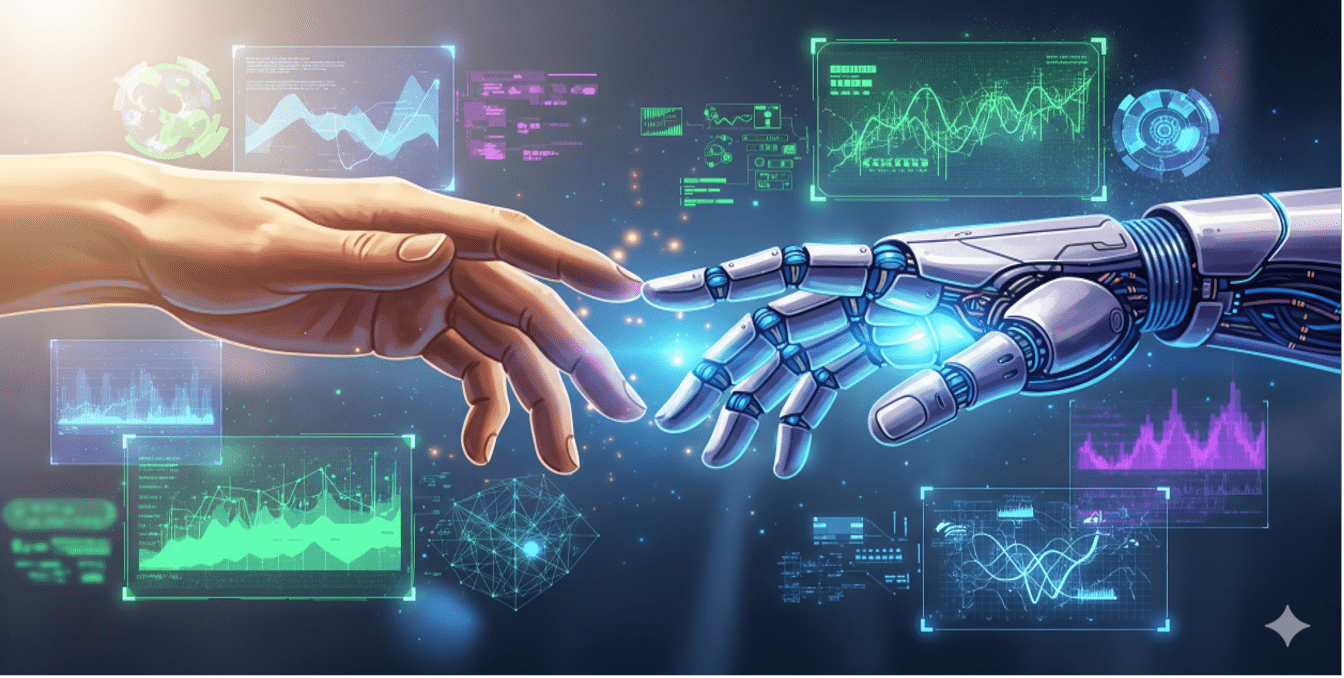
In recent days, I have had conversations with many of my friends working in corporates, and all of them said that their jobs are being affected in one way or another by AI. Some of these friends have even lost their jobs entirely; this sudden event is turning into a disaster, and a new unemployment crisis is now before us. In this article, we will attempt to understand whether the rapid development of Artificial Intelligence (AI) is merely a technological advancement or whether it represents a paradigm shift that is redefining the historical relations between capital and labour.
The Crisis of AI and Jobs

According to recent reports, the increasing use of AI has had a direct impact on entry-level and repetitive tasks, leading to large-scale layoffs[i][ii]. Especially in white-collar jobs, according to a recent Goldman Sachs report, AI could increase unemployment by 10–20% in the next 3–5 years[iii].In countries like India, call centres, manufacturing, and other low-skill jobs are being most affected.
The service sector today is undergoing a huge transformation; earlier, it was assumed that AI would first bring a revolution in the primary (agriculture and allied activities) and secondary (manufacturing) sectors, and only later enter high-skill service areas. But the revolutionary pace at which AI is learning means that even high-skill and creative fields are under threat. At the same time, robotics has not yet advanced to a level of human adaptability that AI can overtake primary and secondary sectors, but corporate adaptation in the service sector has already triggered an unexpected revolution here.
Corporate Profits and Profit Sharing

After the advent of AI, companies’ profits have multiplied in ways that were not possible through human capacity alone. Companies are making extensive use of AI and getting much better work done at lower costs. The clear impact of AI can be seen in the rise in productivity and the reduction of costs. For example, if productivity increases by 15% through the use of AI, companies are earning more profit with fewer employees[iv]. But this profit remains confined to a narrow group (mainly shareholders and top management) — the common employees do not directly receive its benefits[v].
The Role of Employees in AI Training and Compensation
Academic research shows that training AI by employees is an important but undervalued contribution. [vi]Initially, companies had their employees train their AI models, and when those AI systems achieved good accuracy, it was those very professionals who lost their jobs. The problem is that most companies gave their employees only their regular salaries during the AI training phase, while enormous profits were earned from their data and expertise. Now, as AI has developed rapidly, employees were not yet accustomed to it, and thus most people lagged behind and lost their jobs.
Income Inequality, Digital Divide, and India’s Specific Conditions
The broad potential impact of AI is that it will further accelerate income inequality.[vii] In countries like India, where digital skills and educational inequality are very high, low-income and rural communities are being pushed further to the margins by the AI revolution. The digital divide, technological literacy, computer access, etc., can deprive these communities of the opportunity for transformative job transitions[viii].
The New Discourse of Corporate Socialism:
According to the concept of corporate socialism, companies privatise profits, but losses or risks are borne by the government and society. In this context, the question is how the profits gained from AI should be redistributed and how this new economic polarisation should be balanced. This is a major socio-economic question[ix]. To understand the relationship between corporate socialism and AI, it can be explained through two main points:
1. Centralization of Profit:
AI technology enables companies to produce more at lower cost.
- Employee displacement: With the arrival of AI, jobs involving repetitive tasks are under threat. Companies can now get more work done with fewer employees, thereby increasing their profits.
- Owners and shareholders benefit: This productivity increase due to AI directly increases the profits of company owners and shareholders. This benefit does not reach other sections of society, thereby increasing income inequality.
- Privatization of data: A large amount of data is required to train AI models. This data is often collected from employees or ordinary people through their work or behavior. Companies profit from this data, but those who provide it receive no direct benefit or compensation.
This process shows how the benefits of AI get concentrated in the hands of a small group — companies and their shareholders.
2. Socialisation of Risk:
The negative impacts arising from AI fall on society.
- The burden of unemployment: When employees lose their jobs due to AI, the burden falls on the government and society. The government has to spend on unemployment benefits, training programs, and other social security schemes.
- Mental and social stress: Losing a job creates serious mental and economic pressure on individuals and families. This social and psychological cost, which cannot be directly monetarily assessed, has to be borne by society.
- Digital divide: With the increasing use of AI, the gap of digital literacy widens further. Those who lack technical skills or resources are left even further behind, spreading more inequality within society.
In short, the theoretical framework of corporate socialism explains how AI companies keep profits to themselves (centralization of profit), while pushing risks like unemployment, income inequality, and social instability onto society (socialization of risk). This is an important argument that provides a new perspective for understanding the economic and social impacts of AI.)।
Solutions: Retraining, Compensation, and Inclusive Policy
It is indisputable that the rise of Artificial Intelligence (AI) is a transformative force. In academic circles, some see it as a temporary “bubble,” while a progressive section accepts it as an inevitable reality and recognises its potential benefits. In this dialectical scenario, AI must not be seen only as a challenge, but also as an opportunity that, through well-planned interventions, can establish socio-economic balance.
To address the challenges arising from AI-driven innovations, we need a multi-dimensional strategy that not only assists displaced workers but also builds a fair and inclusive future. This strategy should be based on the following key pillars:
- The government and corporates must jointly provide skill re-skilling programs and transitional stipends/compensation for employees affected by AI. The job market is changing rapidly with the advent of AI. For people who have been doing the same type of work for decades, suddenly losing their jobs is a huge shock. Re-skilling programs prepare them for new roles, such as data analytics, AI modeling, or robotics maintenance. Financial assistance ensures that they do not face economic insecurity during the learning process. This is an essential part of social security.
- Companies should adopt a “pay-for-skills” based structure, so that employees whose skills contributed to training AI models receive additional allowances or bonuses. “Skill-based compensation” is a model where employees are given extra pay based on their specific skills and knowledge. In the context of AI, this is particularly important for those employees who helped train AI models through their experience and data.
- To reduce the digital divide, special investment in education, training, and infrastructure is necessary for rural and marginalized communities. The growth of AI and the digital economy may widen this gap further. If people in rural areas remain unaware of AI and related technologies, they will be completely excluded from future jobs. By reducing the digital divide, we can ensure that the benefits of the AI revolution reach all sections of society and that no one is left behind.
- Legal frameworks should be established to ensure that a portion of the profits from AI technologies is returned to employees and society facing job losses (for example, windfall tax, or profit-sharing mechanisms). Some companies are becoming extremely wealthy due to AI, while a large part of society is becoming unemployed. This creates social and economic imbalance. Through such mechanisms, we can establish a just balance between the benefits and risks of AI, thereby ensuring stability and justice in society.
- 4.1. Windfall Tax: A special tax can be imposed on the unexpected and excessive profits companies earn from the use of AI. The revenue generated from this tax can be used to finance social security schemes and training programs for unemployed workers.
- 4.2 Profit-sharing Mechanisms: It can be made mandatory by law that a certain percentage of profits from AI is distributed either to employees or into a social fund.

AI’s development is a reality, and it cannot be ignored. It is not just a technological change but a social and economic revolution. Instead of considering AI merely as a “bubble,” we must focus on making it inclusive for all sections of society. If we do not create the right policies today, AI will deepen the gap between benefits and losses. The time has come to think not only about corporate profits but also about the livelihoods that are at stake.
References
[i] https://jacobin.com/2025/07/artificial-intelligence-worker-displacement-jobs
[ii] https://www.goldmansachs.com/insights/articles/how-will-ai-affect-the-global-workforce
[iii] https://mronline.org/2025/08/18/ai-job-loss-hype-could-serve-as-smokescreen-for-trump-recession/
[iv] https://www.goldmansachs.com/insights/articles/how-will-ai-affect-the-global-workforce
[v] https://theimpactinvestor.com/corporate-socialism/
[vi] https://www.imercer.com/articleinsights/skills-based-comp-and-ai-canada
[vii] https://www.cgdev.org/blog/three-reasons-why-ai-may-widen-global-inequality
[viii] https://jmra.in/archive/volume/11/issue/1/article/16025
[ix] https://theimpactinvestor.com/corporate-socialism/
[x] https://www.imf.org/en/Blogs/Articles/2024/01/14/ai-will-transform-the-global-economy-lets-make-sure-it-benefits-humanity
[xi] https://www.imercer.com/articleinsights/skills-based-comp-and-ai-canada
[xii] https://jmra.in/archive/volume/11/issue/1/article/16025
[xiii] https://theimpactinvestor.com/corporate-socialism/



Leave a Reply