
Introduction
In Rajasthan, women’s health remains a critical yet under-discussed issue, a silent emergency that affects not only individuals but also the well-being of families, communities, and future generations. While policy attention and flagship initiatives such as the Janani Suraksha Yojana (JSY), Mukhyamantri Rajshree Yojana, and Poshan Abhiyan have contributed to measurable progress, many deep-rooted social, economic, and systemic barriers continue to hinder transformative change. From maternal health to mental wellness, from nutritional deprivation to limited access to reproductive rights, women across the state are often forced to navigate a complex web of neglect, stigma, and institutional apathy.
Behind every percentage in a health report lies the story of a real woman, a daughter, mother, or sister, whose voice is rarely heard. Women’s health in Rajasthan is frequently reduced to numerical indicators, overshadowing the lived experiences of those grappling with inadequate services and gender-based disparities. Although data from NFHS-5, Census reports, and health indices reflect improvements in metrics such as institutional deliveries and maternal mortality, they often conceal persistent gaps in access, equity, and dignity. There is an urgent need to move beyond the numbers to hold systems accountable, amplify women’s voices, and reshape healthcare delivery with empathy, inclusivity, and a people-centered approach.
A Socio-Economic Lens on Health Inequality
Rajasthan is a state of contrasts, while urban women may benefit from improved healthcare services and greater awareness, rural and marginalized women often suffer in silence. According to NFHS-5 data (2019-21), only 43.9% of women in rural Rajasthan had access to four or more antenatal care (ANC) visits and institutional delivery. However, even with improvement, many in tribal and remote areas are still left behind. Alarmingly, 54.8% of women aged 15-49 are anaemic, higher than in previous years. 20.8% of women are underweight; intra-household discrimination in food access persists, and only 16% of women have unmet needs for contraception.
Economic dependence on male family members, lower female literacy (65.9% as per Census 2011), early marriages, and cultural taboos contribute significantly to the poor health-seeking behaviour of women. Gender roles ingrained in patriarchy continue to define a woman’s access to food, mobility, and decision-making elements that are vital for a healthy life. These statistics show partial progress but also reveal systemic blind spots, especially in marginalized, rural, and tribal communities.
From Numbers to Narratives
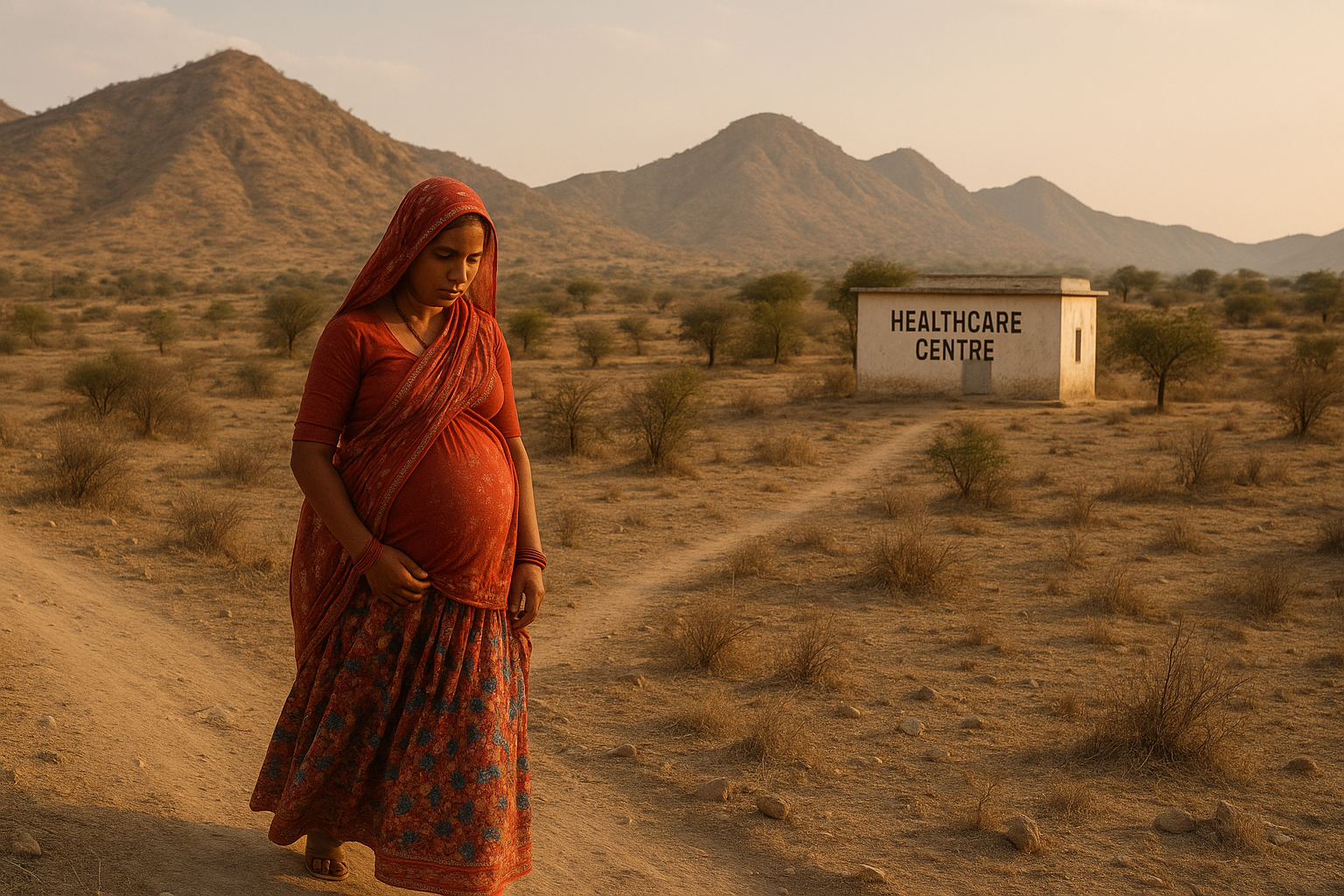
In rural Rajasthan, healthcare for women is not a basic right; it often feels like a luxury. Consider the story of Meera from Karauli, who, in her eighth month of pregnancy, walked several kilometers to a sub-health center, only to find it closed. With no ambulance available, her family had to hire a private vehicle, bearing both financial and physical stress. In tribal belts such as Dungarpur or Udaipur, language barriers, lack of trained female staff, and cultural stigma prevent women from accessing essential health services.
Adolescent girls face even more hurdles dropouts due to menstruation, early marriages, and lack of reproductive health awareness are common. Health workers, too, face enormous pressure. Pushpa, an ASHA worker from Barmer, walks long distances every day to identify high-risk pregnancies. Yet, delayed honorariums and lack of institutional support limit her capacity to serve effectively. These ground-level stories are powerful diagnostic tools that highlight policy implementation failures.
One of the most pressing challenges in women’s healthcare delivery in Rajasthan is the absence of institutional accountability. Despite numerous schemes, gaps persist due to poor planning, monitoring, and responsiveness. Infrastructural deficits are widespread. Many Primary Health Centres (PHCs) and Community Health Centres (CHCs) lack gynaecologists, essential equipment, and round-the-clock delivery services. Benefits under government schemes often do not reach the most vulnerable women, either due to the complexity of paperwork or the absence of awareness campaigns. Although digital dashboards exist for monitoring service delivery, they are not effectively connected to local feedback mechanisms, which leaves critical lapses unaddressed. ASHA and Anganwadi workers, the backbone of health outreach in villages, continue to be underpaid, under-trained, and overworked. Their knowledge and insights rarely inform health policy, even though they directly engage with the communities.
Mental health, though critical, is still largely invisible in the discourse on women’s wellbeing in Rajasthan. Depression, anxiety, postpartum disorders, and trauma from domestic violence are common but go untreated due to cultural stigma and lack of trained personnel. Primary Health Centres seldom include mental health services. Although the District Mental Health Programme is operational on paper, it is underfunded and disconnected from community realities. The absence of female counsellors further alienates women in need. This often results in women suppressing their distress, which manifests in physical ailments or social withdrawal.
To move beyond statistics and create an accountable, gender-sensitive health system, a reimagined approach is needed, one that recognizes community voices and prioritizes women’s lived experiences. Health services should be monitored locally through empowered community health committees that include active participation of women. These platforms can ensure real-time feedback, transparency, and responsiveness at the grassroots level. Budget allocations must reflect the centrality of women’s health needs. This means investing not just in maternal care but also in adolescent health, reproductive services, menopause support, and mental wellness.
ASHA and Anganwadi workers must be formally recognized as healthcare professionals. Their remuneration, training, and social security must reflect the importance of the work they do. Their frontline experiences offer valuable insights into the gaps and successes of health policy and deserve institutional attention. Additionally, both physical and mental health services must be offered in an integrated, accessible manner. Every PHC should be equipped with a counsellor. Tele-counselling services and mobile health vans can bridge the access gap, especially in remote tribal belts. These efforts must be rooted in cultural sensitivity, multilingual outreach, and trust-building with local women.
The health of women in Rajasthan cannot be improved through numbers alone. True progress lies in translating data into dignity by listening to women’s voices, learning from their experiences, and holding systems accountable for their promises. Women’s health must be seen not just as a medical concern, but as a matter of justice, empowerment, and human dignity. From nutrition and maternal care to mental health and reproductive rights, a woman’s health journey reflects her position and value in society.
Conclusion
Improving women’s health in Rajasthan requires more than isolated schemes or temporary campaigns; it calls for a sustained, structural transformation in how we perceive, plan, and prioritize women’s well-being. The time has come to move from reactive approaches to proactive, preventive, and people-centered healthcare delivery. There must be renewed focus on inter-departmental coordination between health, education, nutrition, and social justice departments to design integrated solutions that respond to the multifaceted realities of women’s lives.
Policies should also embrace cultural sensitivity, promote mental health services, and protect women’s reproductive rights through informed choice and quality care. Furthermore, the state must commit to continuous monitoring and community engagement, ensuring that women are not only beneficiaries but active participants in shaping the health system that serves them.
Ultimately, a healthy woman is the cornerstone of a healthy society. Rajasthan must recognize this truth not just in vision documents, but in budgets, institutions, and frontline delivery. Moving forward, we must hold ourselves accountable not only to data but to the lived experiences of the women behind every statistic. Only then can we hope to build a Rajasthan where health is not a privilege, but a guaranteed right for every woman.
References
- Baru, R. V., Acharya, A., Acharya, S., Kumar, A. K. S., & Nagaraj, K. (2010). Inequities in access to health services in India: Caste, class and region. Economic and Political Weekly, 45(38), 49–58. Retrieved from http://www.epw.in
- Chatterjee, P. (2020). India’s ASHAs: The frontline health workers of the pandemic. The Lancet, 395(10231), 1583. https://doi.org/10.1016/S0140-6736(20)31235-4
- Dasgupta, A., & Sarkar, M. (2008). Menstrual hygiene: How hygienic is the adolescent girl? Indian Journal of Community Medicine, 33(2), 77–80. https://doi.org/10.4103/0970-0218.40872
- International Institute for Population Sciences (IIPS) & ICF. (2021). National Family Health Survey (NFHS-5), 2019–21: India Fact Sheet. Mumbai: IIPS. Retrieved from http://www.rchiips.org/nfhs/
- Ministry of Health and Family Welfare (MoHFW). (2021). Annual Report 2020–21. Government of India. Retrieved from main.mohfw.gov.in
- Ministry of Women and Child Development. (2021). Annual Report 2020–21. Government of India. Retrieved from wcd.nic.in
- NITI Aayog. (2020). Healthy States, Progressive India: Report on the Ranks of States and Union Territories. Retrieved from http://www.niti.gov.in
- Planning Commission. (2013). Evaluation Study on Janani Suraksha Yojana (JSY). New Delhi: Government of India. Retrieved from niti.gov.in/planningcommission.gov.in/docs/reports/peoreport/peo/peo_jsy.pdf
- Sharma, D. C. (2015). India’s mental health crisis. The Lancet, 385(9980), 498–499. https://doi.org/10.1016/S0140-6736(15)60164-8
- UNICEF India. (2020). Women’s health in India: Strengthening systems for sustainable outcomes. Retrieved from http://www.unicef.org/india/reports/womens-health-india


Leave a Reply