
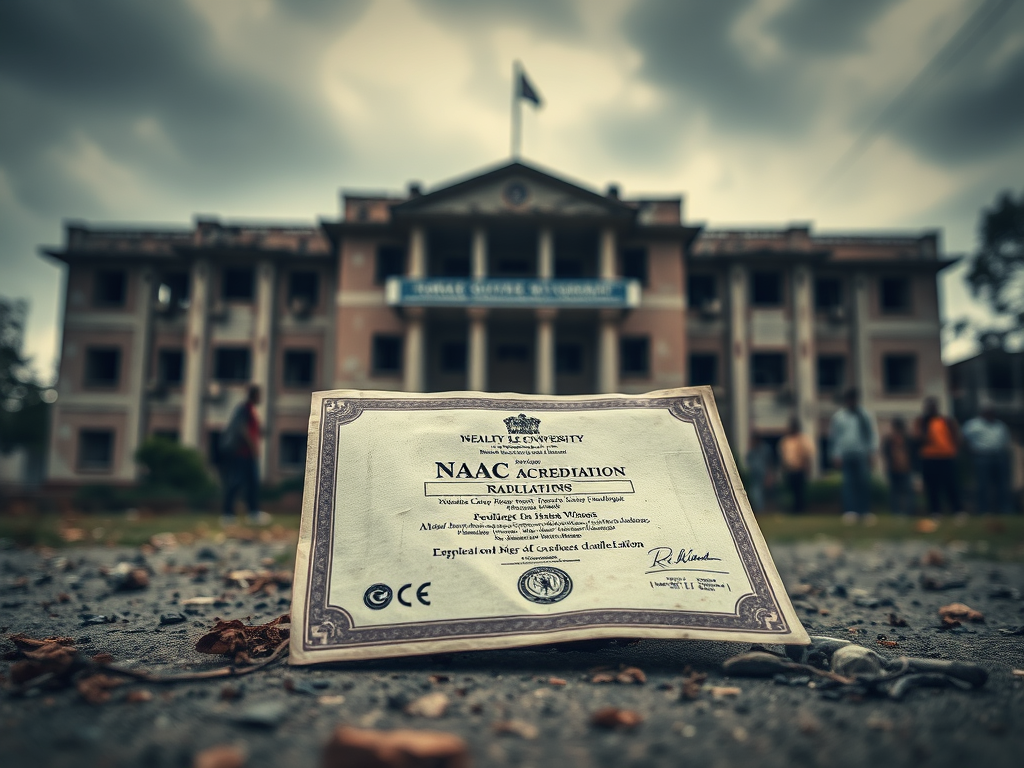
According to the Governor’s House website, Rajasthan is home to 23 state public universities. However, these institutions are merely structures without sufficient substance. Of these 23 universities, only five hold NAAC accreditation certificates. Following strict directives from the governor, an additional five universities have decided to apply for NAAC certification. Unfortunately, the remaining 13 universities are not even eligible to pursue this accreditation. While it is important to note that NAAC certification does not guarantee the quality of education, the agency itself has faced significant criticism and has compromised. Nevertheless, if we consider the NAAC certificate as a minimum criterion for a university, the current state of universities in Rajasthan is alarmingly beyond repair.
Among the five universities that hold NAAC accreditation, only the University of Rajasthan has achieved an A+ status. The other four universities are accredited but are in poor condition overall. The universities with valid accreditation are as follows: Jai Narain Vyas University, Jodhpur (B++), Mohan Lal Sukhadia University, Udaipur (A), Vardhman Mahaveer Open University, Kota (A), Maharaja Ganga Singh University, Bikaner (C), and University of Rajasthan, Jaipur (A+). Grades like C represent the lowest tier, indicating that these institutions offer little more than physical infrastructure. Given the challenging conditions within even the NAAC-accredited universities, one can only speculate on the state of those institutions that do not even meet the eligibility requirements for accreditation.
Universities such as Pandit Deendayal Upadhyaya Shekhawati University in Sikar, Raj Rishi Bharthrihai Matsya University in Alwar, Govind Guru Tribal University in Banswara, and Maharaja Surajmal Brij University in Bharatpur are not eligible for certification. The main reason for this ineligibility is that these universities do not have a single permanent faculty member or have only a nominal number of permanent faculty compared to the sanctioned positions.
This raises an important question: if these universities lack qualified teachers, can we truly call them universities, or are they just buildings? Furthermore, if they do not have faculty, how are they able to offer undergraduate and postgraduate courses, and even PhD programs? It’s important to note that these are not newly established universities; they have been operating for over ten years. This ongoing situation reflects the mentality and lack of seriousness about education from our politicians. Many of them are quick to give speeches about the future of Vishwaguru Bharat, yet no one acknowledges that without functional universities, India cannot aspire to be a world leader.
Instead, these institutions have become degree distribution factories, devoid of genuine education and learning. Who are the students enrolled in these universities? They are often the most marginalised individuals, poor students from rural areas who come to these institutions in search of a better future. Unfortunately, they remain unaware that by enrolling in such universities, they may be jeopardising their careers and futures.
This situation presents a trap for students. If an undergraduate student does not receive adequate learning during their course, they will struggle to apply to prominent universities in India or abroad. Without a solid foundation, students may find themselves compelled to apply only to the same university or to others with similar conditions, as they will not meet the eligibility requirements of better universities. Consequently, these institutions become a trap for students, particularly those from poor rural areas.
The situation is even more challenging for female students. Given the conservative nature of our society, girls are often not allowed to pursue education beyond their local areas. Unfortunately, the only options available to them are these local universities. As a result, even with undergraduate, postgraduate, or even PhD degrees, many of these women remain unemployed. They are often forced to prepare for government jobs, where the conditions are also dire, with frequent paper leaks and delays in competitive examinations becoming the norm. In short, these universities can turn into places that hinder career development. But who is responsible for this situation? Analysing the data reveals that both universities and the government share responsibility for these adverse conditions.
The Vice Chancellor (VC) is the most important administrator in universities, but how are they appointed? Their appointments are often not based on credentials or qualifications; rather, they result from political affiliations. Furthermore, political connections are not the sole factor in these appointments. Sycophancy plays a larger role, leading to the selection of individuals who are often corrupt and incompetent, prioritizing their political superiors over the academic community. As a result, all the universities struggle with irregular academic schedules. For instance, when examining the PhD admission process in the universities of Rajasthan, it’s clear that none of them have a consistent procedure. The completion of PhD admissions typically takes years, and after admissions are finalized, there are often further delays of months or even years before coursework begins. Pursuing a PhD in such institutions can feel more like a punishment than an academic endeavor, with little chance for career advancement.
Students often experience mental distress at every stage of their PhD journey due to the administration’s inefficiencies. Many students lack clarity about their future; they don’t know who their teachers or supervisors will be or who will be instructing their courses. Furthermore, the faculty members they encounter are frequently unqualified and don’t have any interest in scholarship.
With the university administrations, Governments are responsible for the state of higher education because they often neglect its importance. If they lack funding, why do they open universities? Additionally, governments do not appoint faculty for these universities. Many institutions are not receiving enough funding to operate effectively. Furthermore, there is no mechanism in place for gathering feedback about the education provided by the universities.
What is the solution to the dire state of higher education in Rajasthan? Simply highlighting the problems and weaknesses of the universities will not lead to improvement. Our goal is to enhance higher education in Rajasthan, as it directly impacts the future of our state and, consequently, the future of all of us and the next generation. At the government level, the most crucial first step is to provide sufficient funding to the universities. The second important step is to ensure adequate recruitment of faculty at all universities. Without proper funding and faculty, a university cannot function effectively. After securing funding and faculty, a feedback mechanism should be established, with input primarily coming from students rather than high-level authorities.
Additionally, regular student union elections and separate research union elections should be conducted in all public universities in Rajasthan. While these steps will not guarantee complete improvement, they are essential foundational actions. Without implementing these basic changes, we cannot even consider additional reforms. However, given that governments in India and Rajasthan are often not very liberal, a collective effort is essential to improve the condition of higher education in the state. Scholars have a responsibility to unite and advocate for this common cause. Since scholars possess expertise in data analysis, we should gather information using Right to Information (RTI), annual reports, and other means. Thus, we should advocate on multiple fronts, including in courts, through discussions and debates in academia, raising awareness on social media, and organizing protests on the streets. With consistent effort in these areas, we can create meaningful change.


Leave a Reply