
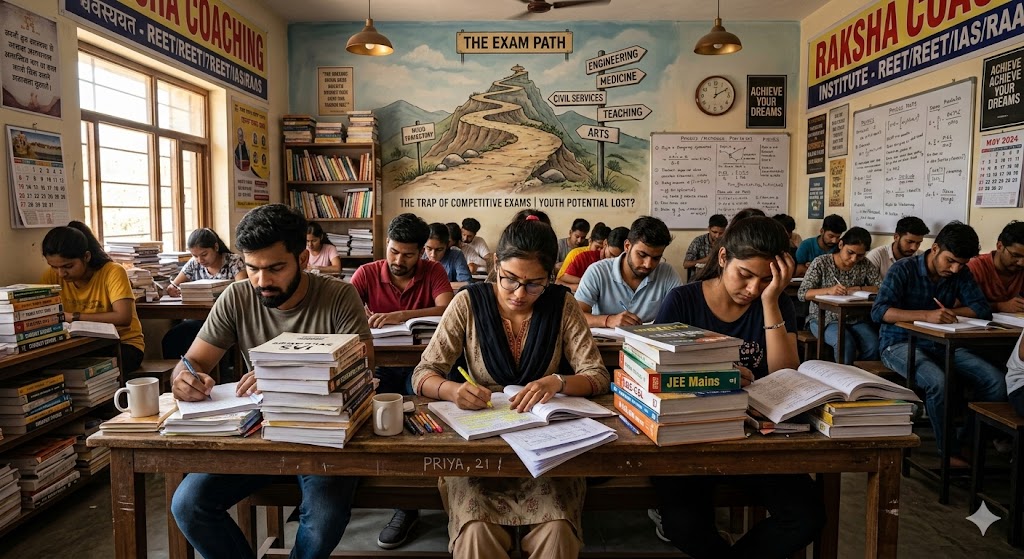
It is not uncommon in Rajasthan to come across a graduate who has invested four, five, or even seven years in preparing for a competitive government examination. In urban areas such as Jaipur, Kota, and Jodhpur, whole areas are organized around coaching institutes, test series, and candidates living in shared accommodations. For many families, a government job symbolizes security, respect, and social mobility. For candidates, it symbolizes predictability in an unpredictable job market.
“The competitive examination ecosystem has the potential to create a structural misallocation of human capital.”
However, this aspiration conceals a significant economic puzzle: What are the implications when a significant proportion of educated youth dedicate several years of their productive lives to preparing for a low-probability outcome? When recruitment cycles turn irregular and job vacancies are postponed, what are the opportunity costs of waiting? And what are the implications for the overall human capital path in Rajasthan?
This article contends that the “competitive examination ecosystem” in Rajasthan, together with the absence of private sector absorption and irregular recruitment cycles, has the potential to create a structural misallocation of human capital. The problem is not about aspiration but about incentives, probabilities, and long-term economic implications.
Probability, Delay, and Risk
Delays in the notification, examination, or appointment process in competitive exams in Rajasthan, whether for administrative services, teaching, or clerical recruitment, are common. As a result of unpredictable recruitment cycles, the “waiting period” extends.
In expected utility theory, the impact of uncertainty in timing is substantial. If the probability of selection is low and uncertain, the risk-adjusted return is reduced.
Still, candidates persist.
Why?
The explanation is partially rooted in structural conditions in the labour market.
Labour Market Structure and Public Sector Premium
The absorption capacity of the private sector in Rajasthan is not uniform over different areas. Industrial estates are present, but large numbers of graduates, especially from arts, humanities, and general degree courses, have restricted formal employment opportunities in their immediate areas.
A segmented labour market is formed:
- A secure and prestigious public sector
- A fragmented and insecure private or informal sector
In labour economics, when one sector provides substantially better stability and wage differentials, queuing theory applies. People are prepared to be unemployed or underemployed while waiting for entry into the public sector.
This has been noticed in many developing countries, where public sector employment is a rationed good.
Thus, the competitive exam ecosystem is not irrational; it is shaped by relative wage structures and labour market segmentation.
The time spent on exam preparation is not necessarily wasted. It involves learning, hard work, and mental effort. However, if the preparation takes several years without skill diversification, it may result in skill specialisation.
“Delayed entry into the labour market reduces the number of productive years and the cumulative earnings.”
The opportunity cost of preparation includes:
- Opportunity cost of work experience
- Loss of income
- Opportunity cost of career development
- Opportunity cost of skill development
The human capital theory argues that early work experience has a profound effect on lifetime earnings. Delayed entry into the labour market reduces the number of productive years and the cumulative earnings.
If thousands of graduates’ delay entry into the labour market for extended periods of exam preparation, the overall productivity impact is:
- Decreased participation of educated youth in the labour market
- Skill development stagnation
- Decreased entrepreneurial risk-taking
From a macroeconomic perspective, this is the potential underutilisation of human capital.
Kota: A Microcosm of Concentrated Aspirational Risk
In Kota, Rajasthan, whole neighbourhoods are structured around aspiration. Hostels are lined up on the roads. Coaching centres occupy billboards. Libraries function late into the night. Every year, an estimated 1.5 to 2 lakh students pour into the city to prepare for competitive exams like JEE and NEET, turning Kota into what is famously known as India’s largest coaching centre. Kota symbolizes more than an educational hub; it symbolizes a model of massive human capital investment.
“When the whole population has statistically insignificant probabilities of success, it leads to what economists call a lottery equilibrium.”
Kota symbolizes the massive aggregation of students preparing for competitive exams. Unlike an industrial hub, which is known for the production of goods or technological innovation, Kota is known for the production of students for competitive exams. It is an economy that is probabilistically driven.
This is not necessarily inefficient. An educational hub can lead to knowledge spillovers, peer learning, and performance discipline. But when the whole population has statistically insignificant probabilities of success, it leads to what economists call a lottery equilibrium, where many people invest heavily for a few high-reward outcomes.
The magnitude of the growth of the city indicates the level of demand for upward mobility. But it also indicates the level of risk exposure among the youth.
Behavioural Distortions in Decision-Making
Economic models assume that people make correct interpretations of probabilities. This is disputed by behavioural economics.
- Optimism Bias: Applicants tend to think they have a better chance of passing than the actual probability.
- Overweighting of Small Probabilities: Prospect theory shows that people give too much weight to low-probability, high-payoff options, such as lottery tickets.
- Sunk Cost Fallacy: Since several years of preparation have been invested, withdrawal appears as a loss, and hence continued preparation is done despite low returns.
- Herd Behaviour: Since communities prepare together, social pressures continue the preparation process.
- Prestige Signalling: Preparation for government jobs is a signal of ambition and seriousness, and hence continued social legitimacy is maintained even if there are no jobs.
Critique by Sanjeev Sanyal and the National Context
Economist Sanjeev Sanyal, who is part of the Prime Minister’s Economic Advisory Council, has also criticized India’s deep-rooted obsession with elite competitive exams. In media interactions, he has pointed out the extremely low chances of selection in exams like the UPSC Civil Services and questioned whether spending years preparing for a sub-1% success probability is an efficient utilization of national talent.
His critique is not directed at public service but is an economic commentary on allocation efficiency. As a dynamic economy increasingly values technological adaptability, risk-taking entrepreneurship, and skill diversification, there could be opportunity costs associated with extended withdrawal from productive labor market participation.
The competitive environment in Rajasthan reflects this national scenario. While Kota might be exclusively focused on engineering and medical entrances, Jaipur and other urban areas are hubs for rigorous preparation for state administrative and teaching jobs. They collectively represent a pipeline that funnels massive numbers of youth into a small number of public sector jobs.
Labour Market Structure and Queuing
The existence of competitive preparation cannot be explained without considering the structure of Rajasthan’s labor market.
Public Sector Jobs Provide:
- Increased job security
- Reduced volatility
- Formalized benefits
Conversely, large parts of the private sector, especially in semi-urban areas, may provide:
- Contract employment
- Instability of wages
- Limited long-term job security
This wage-security differential gives rise to queuing. People prefer to wait for entry into the public sector rather than settle for inferior private sector jobs.
From an economic perspective, this is akin to a segmented labor market equilibrium, where one market becomes scarce and hotly contested.
But there are costs to extended queuing. This leads to higher youth dependency ratios, lower entrepreneurial entry rates, and risk concentration in a narrow occupational pipeline.
Macroeconomic and Social Implications
When thousands are stuck in extended preparation cycles:
- Youth unemployment rates underestimate “waiting unemployment.”
- The potential consumption capacity of young households remains low.
- Psychological distress rises because of repeated cycles of failure.
- Marriage and household formation are postponed.
For a state that aspires to fast-track growth, human capital must be channelled into productivity. A system that funnels excessive amounts of time into narrow public sector gateways might limit diversification.
On the other hand, competitive exams have a legitimate role in governance. The public sector needs competent administrators, teachers, and bureaucrats. The problem is one of scale, transparency, and timeliness.
Is It Truly a Trap?
The “trap” metaphor may be too simplistic. For most, success in competition changes family destinies. Government jobs have always facilitated social mobility, especially for first-generation university graduates.
The problem arises when:
• Recruitment schedules are unpredictable
• Vacancy information is not transparent
• Skill fall-backs are not developed
Aspiration becomes the norm rather than an option among several.
Then, risk becomes systemic and aspirational risk.
“Reform needs incentive realignment, not the discouragement of aspirations.”
Towards Incentive-Compatible Reform
Reform needs incentive realignment, not the discouragement of aspirations.
1. Predictable Recruitment Schedules – Statutory schedules minimize uncertainty and risks.
2. Transparent Selection Information – Public dashboards with applicant numbers, vacancy ratios, and stage-wise filtering help informed decision-making.
3. Skill-Integrated Coaching Ecosystems – Digital literacy, communication skills, and data competencies are integrated to ensure fall-back employability.
4. Improving Private Sector Absorption – Industrial policies and MSME development can reduce over-reliance on government sector jobs.
5. University-Level Career Diversification – Undergraduate universities need to increase internship opportunities and career counseling to diversify aspiration sets.
The intention is not to abolish competitive exams but to prevent them from monopolizing the allocation of youth talent.
Conclusion: Rebalancing Aspiration and Allocation
Kota is a metaphor for aspiration. It is an indicator of the remarkable willingness of families to invest in the pursuit of success. The competitive ecosystem in Rajasthan embodies a belief in meritocratic progress.
However, economics forces a tough question: “If the chances of success are extremely low and the preparation times span the best working years, then how viable is this allocation system?”
The critique by Sanjeev Sanyal highlights this larger structural problem – not to dismiss the importance of aspiration but to challenge whether the countries and state’s human capital is being allocated in the most optimal manner.
The problem statement for Rajasthan is clear. Expansion in higher education has opened up opportunities. The task ahead is to ensure that these opportunities are converted into diverse and productive employment streams.
Aspiration has to continue. However, it has to be balanced with a structural framework that can minimize uncertainty, maximize choices, and shield youth from the adverse impacts of aspirational risks.
References:
- https://education.economictimes.indiatimes.com/news/higher-education/rajasthan-rules-telangana-rises-jee-main-2026-session-1-results-map-indias-engineering-ambition/128771069
- Ltd, C. E. (2026, February 6). Why most students fail in competitive exams? How to avoid these traps? GK Publications.
- https://gkpublications.com/blogs/news/why-most-students-fail-in-competitive-exams-how-to-avoid-these-traps?srsltid=AfmBOorbD7ZOb5bYAHsnxV55AGQBndVqWiD6bk-rCH9_QLzFIqYqyAg2




Leave a Reply